

What Are Ambient AI Scribes, and Why Do Clinicians Care?
Ambient scribe software (AMBS) listens to the clinician–patient conversation and drafts a structured note automatically. Unlike dictation tools such as Dragon, which transcribe what you say, AMBS filters natural conversation and writes a summary in chart format (Tierney et al., 2024). Evidence suggests AMBS cut charting time and may reduce burnout (Olson et al., 2025).
Although AMBS can improve the efficiency of patient care, hype and excitement drown out the downsides of this useful technology. Chief among them is hallucination: confidently making things up and entering wrong patient information into the electronic health record (EHR). Think of an overconfident intern who has never met your patient but writes their entire history anyway, in flawless grammar.
We know AMBS can hallucinate, yet clinicians happily sign the note. Clinicians bear the liability; vendors bear none. The vendor's rebuke is, at most, a sternly worded blog post or a newspaper article about a patient who found false information in her record after a visit in which her clinician used an AMBS (Ynet News, 2026).
This write-up covers how AMBS are classified, how to choose one that fits your workflow, and how to reduce hallucinations and erroneous notes (hint: read the note before signing).
Types of Ambient Scribes: Size, Maturity and Extras
- Vendor size: small, such as Freed and Nabla; medium, such as Ambience and Suki; large, such as Microsoft (Dragon Copilot) and Epic's EHR.
- Time on market: under three years, such as Epic AI Charting; over three years, such as Microsoft Dragon Copilot (formerly DAX).
- Parent company age: under five years (Freed), 5–10 years (Abridge), over ten (Microsoft, Epic).
- Extras: coding/billing, auto after-visit summaries (AVS) and order queuing. Only four of the ten systems we reviewed offer all three.
Ambient Scribe Pros and Cons: The Good, the Bad and the Ugly
Not using AMBS in a busy clinic is like bailing out a boat with a teaspoon while colleagues wave from the dock holding a pump. The advantages are enormous: having tried three different scribe systems, I can tell you they streamline workflow in a busy, fast-paced setting.
The good: evidence is trickling in that AMBS reduce documentation time (Lukac et al., 2025), lower burnout (Olson et al., 2025) and improve eye contact with patients (Pearlman et al., 2025). These advantages should not be ignored, given the many studies on clinician burnout and how to mitigate it (Otokiti et al., 2021).
The bad and ugly: one patient's note recorded psychedelic mushroom use she never reported (Ynet News, 2026). Wrong information about substance use can be devastating, risking loss of privileges such as health insurance and employment. A proposed class action also alleges that a health system recorded visits without consent (Becker's Hospital Review, n.d.-a).
Carmakers recall defective brakes; they do not bill the driver. With AMBS mishaps, however, clinicians typically retain accountability for errors (Becker's Hospital Review, 2026). We feel this is not right, and vendors should share responsibility for their technology's output.
Carmakers recall faulty brakes. In ambient AI, clinicians bear the liability while vendors bear none. We feel this is not right.
Top 10 Ambient AI Scribes Compared
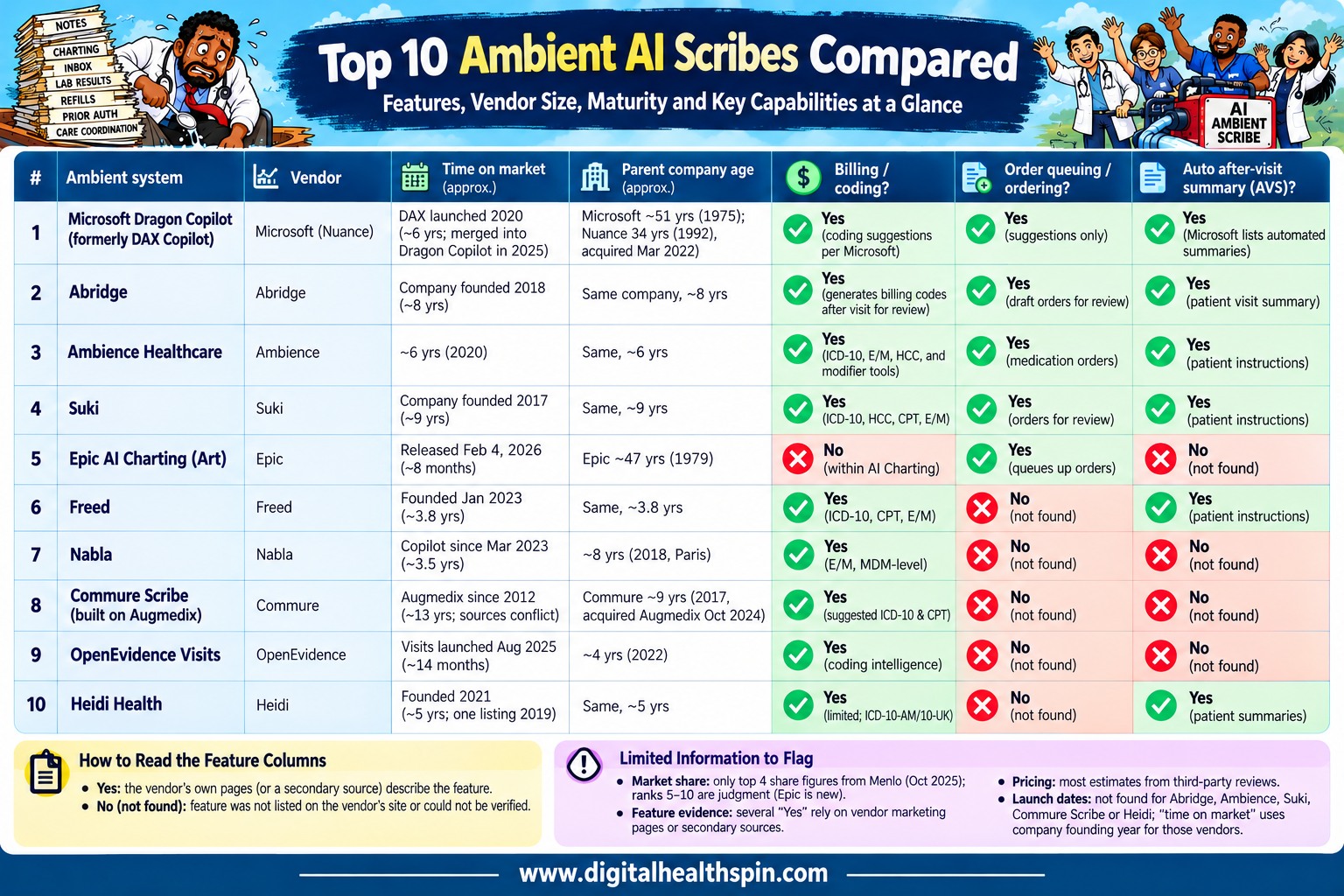
Our comparison is based on the classification above and on the utility each AMBS vendor provides. Below is an overall feature tally, followed by a head-to-head comparison table.
Feature tally
- Billing/coding: 9 of 10 (all except Epic AI Charting, where coding sits in a separate tool, Penny).
- Order queuing/ordering: 5 of 10 (Dragon Copilot, Abridge, Ambience, Suki, Epic). Dragon and Abridge produce suggestions only; Ambience documents medication orders only.
- Auto AVS / patient instructions: 6 of 10 (Dragon Copilot, Abridge, Ambience, Suki, Freed, Heidi).
- All three features (billing/coding, ordering and auto AVS/patient instructions): Dragon Copilot, Abridge, Ambience and Suki. Each of these is enterprise-oriented and sold on custom or unpublished pricing.
Limited information to flag
- Market share: only the top four share figures come from one source (Menlo, Oct 2025). Rankings 5–10 are judgment, especially Epic, which is too new to have share data.
- Feature evidence: several "Yes" answers rest on vendor marketing pages. Nabla's entries partly rely on Commure's blog (a competitor), and Commure's own entries rely on Commure's blog, because the vendors' own pages gave little detail. Abridge's patient summary comes from a secondary source.
- Pricing: most pricing comes from third-party reviews because most vendors do not publish their prices. Treat figures as the closest available estimates.
- Launch dates: first-product launch dates were not found for Abridge, Ambience, Suki, Commure Scribe or Heidi's scribe. "Time on market" uses the company founding year for those companies instead.
View this table as text
| # | Ambient system | Vendor | Time on market (approx.) | Parent company age (approx.) | Billing / coding? | Order queuing / ordering? | Auto after-visit summary (AVS)? | |||
|---|---|---|---|---|---|---|---|---|---|---|
| 1 | Microsoft Dragon Copilot (formerly DAX Copilot) | Microsoft (Nuance) | DAX launched 2020 (~6 yrs; merged into Dragon Copilot in 2025) | Microsoft ~51 yrs (1975); Nuance 34 yrs (1992), acquired Mar 2022 | ✔ | Yes (coding suggestions per Microsoft) | ✔ | Yes (suggestions only) | ✔ | Yes (Microsoft lists automated summaries) |
| 2 | Abridge | Abridge | Company founded 2018 (~8 yrs) | Same company, ~8 yrs | ✔ | Yes (generates billing codes after visit for review) | ✔ | Yes (draft orders for review) | ✔ | Yes (patient visit summary) |
| 3 | Ambience Healthcare | Ambience | ~6 yrs (2020) | Same, ~6 yrs | ✔ | Yes (ICD-10, E/M, HCC, and modifier tools) | ✔ | Yes (medication orders) | ✔ | Yes (patient instructions) |
| 4 | Suki | Suki | Company founded 2017 (~9 yrs) | Same, ~9 yrs | ✔ | Yes (ICD-10, HCC, CPT, E/M) | ✔ | Yes (orders for review) | ✔ | Yes (patient instructions) |
| 5 | Epic AI Charting (Art) | Epic | Released Feb 4, 2026 (~8 months) | Epic ~47 yrs (1979) | ✖ | No (within AI Charting) | ✔ | Yes (queues up orders) | ✖ | No (not found) |
| 6 | Freed | Freed | Founded Jan 2023 (~3.8 yrs) | Same, ~3.8 yrs | ✔ | Yes (ICD-10, CPT, E/M) | ✖ | No (not found) | ✔ | Yes (patient instructions) |
| 7 | Nabla | Nabla | Copilot since Mar 2023 (~3.5 yrs) | ~8 yrs (2018, Paris) | ✔ | Yes (E/M, MDM-level) | ✖ | No (not found) | ✖ | No (not found) |
| 8 | Commure Scribe (built on Augmedix) | Commure | Augmedix since 2012 (~13 yrs; sources conflict) | Commure ~9 yrs (2017, acquired Augmedix Oct 2024) | ✔ | Yes (suggested ICD-10 & CPT) | ✖ | No (not found) | ✖ | No (not found) |
| 9 | OpenEvidence Visits | OpenEvidence | Visits launched Aug 2025 (~14 months) | ~4 yrs (2022) | ✔ | Yes (coding intelligence) | ✖ | No (not found) | ✖ | No (not found) |
| 10 | Heidi Health | Heidi | Founded 2021 (~5 yrs; one listing 2019) | Same, ~5 yrs | ✔ | Yes (limited; ICD-10-AM/10-UK) | ✖ | No (not found) | ✔ | Yes (patient summaries) |
How to read the three feature columns: Yes means the vendor's own pages (or, where noted, a secondary source) describe the feature. No (not found) means it was not found in the vendor documentation accessed. That is not proof the feature is absent, since vendors add features often. Features are as advertised by vendors; no product was tested. Sources for this table are listed in the "Table 1 sources" section at the end. First product launch dates are approximate for most products because specific dates were not found on most vendors' sites. *Microsoft and Epic founding years are general knowledge; no source was retrieved for them.
Ambient Scribe Language Support: Multilingual Visits and Non-English Notes
Below is a summary of the language features of the AMBS we reviewed. We wanted to know whether each supports multilingual visits and whether it can produce notes in a language other than English. See the table that follows for a head-to-head language comparison.
- Multilingual visits: 6 of the AMBS we reviewed support multilingual visits: Dragon Copilot, Abridge, Suki, Freed (vendor claim), Commure Scribe and Heidi Health (beta). We found no such statement for Nabla, Ambience, Epic AI Charting or OpenEvidence Visits.
- Non-English notes: most vendors can listen in many languages, but Abridge, Suki and Freed (apart from patient instructions) write the note in English. Only Commure and Heidi clearly offer non-English output on demand, and Dragon uses the administrator's default language.
- Counts are not comparable: vendors count dialects differently (Nabla lists four Arabic variants; Dragon lists Bangla and Bengali separately), and accuracy by language is rarely published.
- Other extras: the bundled-versus-paid details are in the table. Most pricing comes from third-party reports because several vendors do not publish prices.
Table Comparing Ambient Scribe Language Support
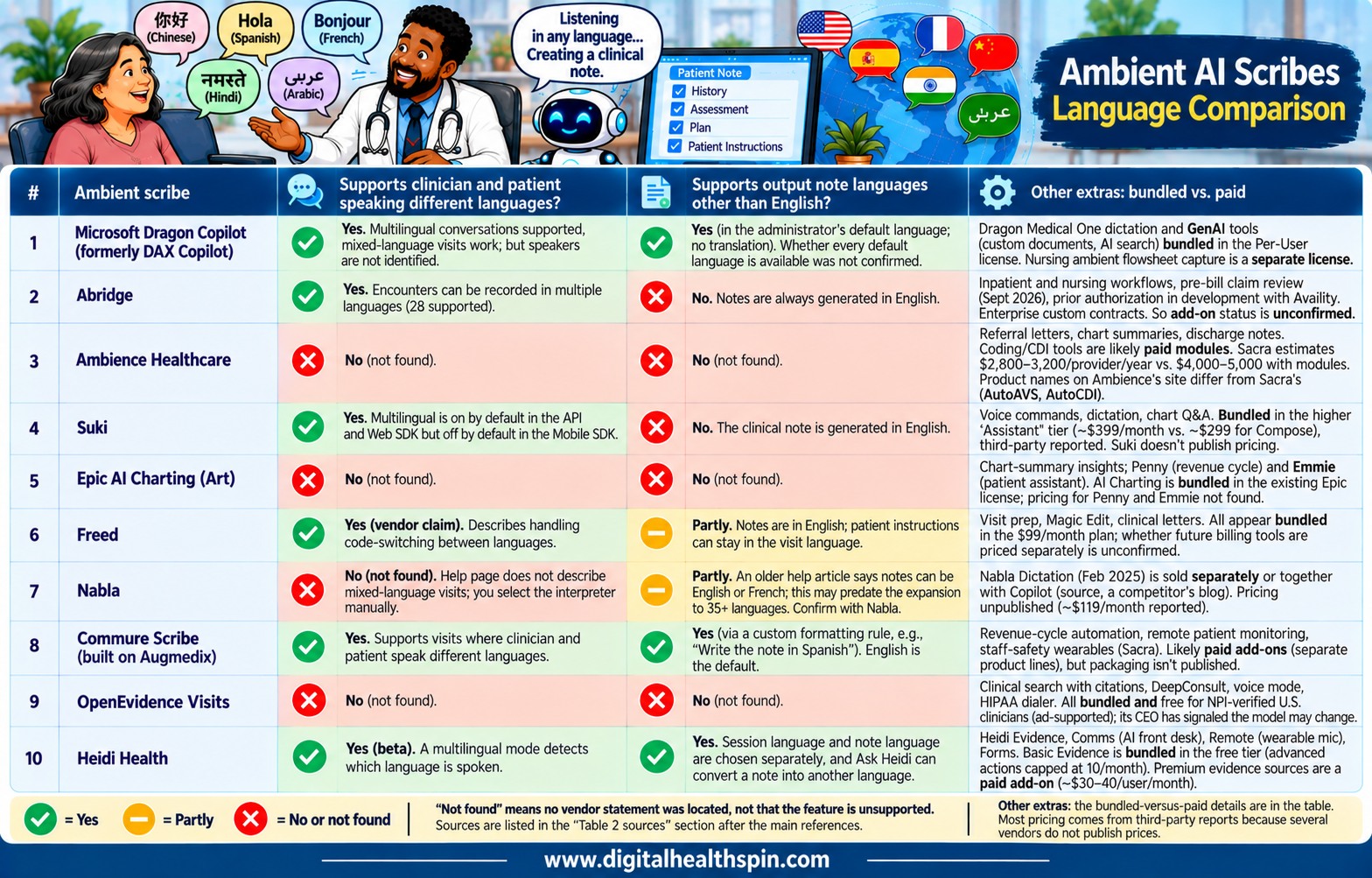
View this table as text
| # | Ambient scribe | Supports clinician and patient speaking different languages? | Supports output note languages other than English? | Other extras: bundled vs. paid | ||
|---|---|---|---|---|---|---|
| 1 | Microsoft Dragon Copilot (formerly DAX Copilot) | ✔ | Yes. Multilingual conversations are supported, and mixed-language visits work, but speakers are not identified. | ✔ | Yes (in the administrator’s default language; no translation). Whether every default language is available was not confirmed. | Dragon Medical One dictation and GenAI tools (custom documents, AI search) bundled in the Per-User license. Nursing ambient flowsheet capture is a separate license. |
| 2 | Abridge | ✔ | Yes. Encounters can be recorded in multiple languages (28 supported). | ✖ | No. Notes are always generated in English. | Inpatient and nursing workflows, pre-bill claim review (Sept 2026), prior authorization in development with Availity. Enterprise custom contracts, so add-on status is unconfirmed. |
| 3 | Ambience Healthcare | ✖ | No (not found). | ✖ | No (not found). | Referral letters, chart summaries, discharge notes. Coding/CDI tools are likely paid modules: Sacra estimates $2,800–3,200/provider/yr base vs. $4,000–5,000 with modules. Product names on Ambience’s site differ from Sacra’s (AutoAVS, AutoCDI). |
| 4 | Suki | ✔ | Yes. Multilingual is on by default in the API and Web SDK but off by default in the Mobile SDK. | ✖ | No. The clinical note is generated in English. | Voice commands, dictation, chart Q&A. Bundled in the higher “Assistant” tier (~$399/mo vs. ~$299 for Compose), third-party reported; Suki doesn’t publish pricing. |
| 5 | Epic AI Charting (Art) | ✖ | No (not found). | ✖ | No (not found). | Chart-summary Insights; Penny (revenue cycle) and Emmie (patient assistant). AI Charting is bundled in the existing Epic license, per this report; pricing for Penny and Emmie not found. |
| 6 | Freed | ✔ | Yes (vendor claim). Describes handling code-switching between languages. | – | Partly. Notes are in English; patient instructions can stay in the visit language. | Visit prep, Magic Edit, clinical letters. All appear bundled in the $99/mo plan; whether future billing tools are priced separately is unconfirmed. |
| 7 | Nabla | ✖ | No (not found). The help page does not describe mixed-language visits; with an interpreter, you select the interpreter language. | – | Partly. An older help article says notes can be English or French; this may predate the expansion to 35+ languages. Confirm with Nabla. | Nabla Dictation (Feb 2025) is sold separately or together with Copilot (source, a competitor’s blog). Pricing unpublished (~$119/mo reported). |
| 8 | Commure Scribe (built on Augmedix) | ✔ | Yes. Supports visits where clinician and patient speak different languages. | ✔ | Yes (via a custom formatting rule, e.g., “Write the note in Spanish”). English is the default. | Revenue-cycle automation, remote patient monitoring, staff-safety wearables (Sacra). Likely paid add-ons (separate product lines), but packaging isn’t published. |
| 9 | OpenEvidence Visits | ✖ | No (not found). | ✖ | No (not found). | Clinical search with citations, DeepConsult, voice mode, HIPAA dialer. All bundled and free for NPI-verified U.S. clinicians (ad-supported); its CEO has signaled the model may change. |
| 10 | Heidi Health | ✔ | Yes (beta). A multilingual mode detects which language is spoken. | ✔ | Yes. Session language and note language are chosen separately, and Ask Heidi can convert a note into another language. | Heidi Evidence, Comms (AI front desk), Remote (wearable mic), Forms. Basic Evidence is bundled in the free tier, which caps advanced actions (Ask Heidi, custom templates) at 10/month. Premium evidence sources are a paid add-on (~$30–40/user/mo; sources differ). |
“Not found” means no vendor statement was located, not that the feature is unsupported. Sources are listed in the “Table 2 sources” section after the main references.
Other extras: the bundled-versus-paid details are in the table. Most pricing comes from third-party reports because several vendors do not publish prices.
How to Choose an Ambient Scribe for Your Practice
- Match your size. AMBS suit different practice sizes. For example, Freed targets small practices of roughly ten clinicians or fewer (Freed, n.d.), and OpenEvidence's free scribe suits solo clinicians.
- Weigh vendor type. Large vendors are robust, as Mayo Clinic's dedicated AI teams show (Becker's Hospital Review, n.d.-b), but costlier and less personal. Startups are nimbler and more responsive to customers, but fix turnaround can be longer. Negotiate favorable support terms before procurement. Like every technology, AMBS will need upgrades, fixes and maintenance along the way, so consider how much in-house tech support you have.
- Check your ecosystem. Already on Microsoft or Epic? Starting there may make sense, since you are already on their system. These are also well-established companies with deep research and development budgets, so expect them to keep giving startups a run for their money in the race for AMBS market share.
- Keep contracts short. Avoid five-year lock-ins. Remember the EHR monopoly? Let us proclaim "never again" to the vendor lock-in we have suffered with EHR systems. Entry barriers are low and moats are thin in this race, because the agentic and LLM technologies behind these systems are freely available to many innovators and developers. We believe more companies will spring up and the technology will keep improving, as this is just the beginning. Do not get locked in with a vendor that is not keeping pace with industry standards.
- Consider IT infrastructure and technical requirements of implementation as a basis of comparison.
- Shortlist three look-alikes. With so many options, there is no reason not to get the AMBS that best fits your practice. Compare implementation support, price, language options and other extras across at least three vendors with similar profiles. For example, if you are considering Microsoft's Dragon, compare it with Epic and Abridge; compare Nabla with Suki and Ambience; compare Heidi with Commure Scribe. This exercise is essential before you choose.
Need help choosing an ambient scribe system? Feel free to reach out for assistance: Contact us
How to Reduce Ambient Scribe Hallucinations: 4 Practical Steps
Many fixes for hallucination are technical, such as enforcing strict citation and provenance tracking. Even so, there are things we users can do to reduce errors.
- Use a simple, bulleted note template. When the system asks you to choose an output format, pick a simple, highlighted or bulleted template over free-flowing prose. Most clinicians skim the output note, and inaccuracies are easier to spot in a bulleted format than when buried in prose. Reviewers also note that fluent prose hides these errors (BERI, n.d.).
- Audit regularly. Spot-check final chart notes against the raw audio or transcript to catch recurring error patterns, then share them with the vendor so the model can be fine-tuned for accuracy.
- Check negations, medications and the plan first. Omissions and hallucinations are common even in good notes: in a UC Davis pilot, 18% of reviewed notes had omissions, 11.5% had hallucinations, and 5.3% had errors rated serious if left uncorrected (Taylor et al., 2026). In a simulated-consultation study, negation errors (for example, "no" dropped from a finding) made up about 30% of hallucinations, concentrated in the plan section (Asgari et al., 2025, as summarized by BERI, n.d.). Slow down at "no," "denies," drug names and doses.
- Watch your own edit rate and pilot first. In the same pilot, 14.9% of notes were signed unedited, and the share of words edited ranged from 1.9% to 69.3% across physicians. The authors recommend piloting a tool before wide use and tracking unedited and heavily edited notes to detect declining vigilance (Taylor et al., 2026). If your unedited rate creeps up, look harder.
Digital Health Spin Perspective: Choose Wisely, Not Hastily
AMBS save time, but they still need oversight, vendor responsibility and evidence-based evaluation. At present, there are no standardized, independently verified metrics to compare output accuracy and hallucination rates across products. Vendors' stated multilingual accuracy is likewise not independently confirmed. Despite these limitations, we can make the best of this nascent technology by doing our own due diligence. We offer these insights across four dimensions: clinical value, economic sustainability, environmental impact and health equity.
Clinical value: fix the workflow first, before implementing any technology. AMBS is just a tool in the toolbox and will not fix the woes of an inefficient process. Resist investing out of FOMO without the due diligence suggested above; a Ferrari engine in a Model T just scatters bolts and does not make the Model T faster.
Fix the workflow first. A Ferrari engine in a Model T does not make the car faster; it makes the bolts fly off.
Economic sustainability: do not over-invest. Technology gets cheaper and better over time. An IBM 7090 mainframe cost about $20 million in today's money and held 144 KB of memory; a typical laptop costs a few thousand dollars, roughly 6,000 times less, and holds about 16 GB (Slashdot, 2021). AMBS are relatively new and this is just the beginning, so better products at better prices will spring up.
Environmental impact: before purchase, compare the infrastructure and memory use of each AMBS. This is often an ignored part of our digital health investments, and these tools add up to environmental cost. Be lean in your choice: the best output, price and support with the least environmental impact.
Health equity: does the tool serve diverse accents and output languages, and does it support clinicians and patients who speak different languages? See the language comparison above.
Enjoyed this? Get digital health insights, sans hype.
Our free newsletter lands in your inbox every two weeks with evidence-based analysis for clinicians and health leaders.
Join the conversation: LinkedIn group · X · Facebook
References
1. Tierney, A. A., et al. (2024). Ambient artificial intelligence scribes to alleviate the burden of clinical documentation. NEJM Catalyst, 5(3). https://doi.org/10.1056/CAT.23.0404
2. Olson, K. D., et al. (2025). Ambient AI scribes and clinician burnout. JAMA Network Open. Summary: UChicago Medicine
3. Lukac, P. J., et al. (2025). AI scribes and physician documentation time and well-being: A randomized trial. NEJM AI. https://doi.org/10.1056/AIoa2501000; summary: UCLA Health
4. Pearlman, K., et al. (2025). Ambient AI and patient connection. JAMA Network Open. Summary: UChicago Medicine
5. Ynet News. (2026, August 18). Her doctor's AI scribe put psychedelic mushrooms in her medical record. https://www.ynetnews.com/health_science/article/hjokotzvzg
6. Becker's Hospital Review. (n.d.-a). Patient sues Sharp HealthCare over ambient AI use. https://www.beckershospitalreview.com/healthcare-information-technology/ai/patient-sues-sharp-healthcare-over-ambient-ai-use/
7. Becker's Hospital Review. (2026). Who owns ambient AI documentation errors? https://www.beckershospitalreview.com/healthcare-information-technology/ai/who-owns-ambient-ai-documentation-errors/
8. Freed. (n.d.). Using an AI scribe in small practices. https://getfreed.ai/blog/using-an-ai-scribe-in-small-practices
9. Becker's Hospital Review. (n.d.-b). Which health systems have AI chiefs? https://www.beckershospitalreview.com/healthcare-information-technology/which-health-systems-have-ai-chiefs/
10. Otokiti, A. U., et al. (2021). Beyond Getting Rid of Stupid Stuff in the Electronic Health Record (Beyond-GROSS): Protocol for a user-centered, mixed-method intervention to improve the electronic health record system. JMIR Research Protocols, 10(3), e25148. https://pubmed.ncbi.nlm.nih.gov/33724202/
11. Slashdot. (2021, December 26). A quadrillion mainframes on your lap (IBM 7090 cost and memory versus a modern laptop). https://hardware.slashdot.org/story/21/12/26/0120254/a-quadrillion-mainframes-on-your-lap
12. Taylor, S. L., Jost, M., MacDonald, S., et al. (2026). Quality of clinical notes created by ambient listening generative AI: Pragmatic prospective pilot study. JMIR Medical Informatics, 14, e86474. https://medinform.jmir.org/2026/1/e86474
13. Asgari, E., et al. (2025). A framework to assess clinical safety and hallucination rates of LLMs for medical text summarisation. npj Digital Medicine. https://pmc.ncbi.nlm.nih.gov/articles/12075489/ (figures taken from the BERI summary below; the article itself could not be opened)
14. BERI. (n.d.). NHS AI scribes: negation drop, clinician review and field reconciliation. https://www.beri.net/article/nhs-ai-scribes-negation-drop-clinician-review-field-reconciliation
Table 1 sources (Top 10 comparison)
Links removed from the table are listed here by system.
1. Microsoft Dragon Copilot (formerly DAX Copilot)
Official website / product page: https://www.microsoft.com/en-us/health-solutions/clinical-workflow/dragon-copilot
Time on market (Intuition Labs): https://intuitionlabs.ai/articles/suki-vs-nuance-dax-vs-abridge-vs-freed
Parent company age (acquired Mar 2022): https://en.wikipedia.org/wiki/Nuance_Communications
Order queuing (presented as suggested orders): https://support.microsoft.com/en-US/dragon-copilot/physicians/manage-orders
2. Abridge
Official website / product page: https://abridge.com
Billing / coding (for clinician review): https://www.hcinnovationgroup.com/analytics-ai/generative-ai/news/55383776/abridge-seeks-to-connect-care-delivery-payment-research
Order queuing (surface after the visit): https://www.abridge.com/blog/orders-real-time-clinical-documentation
After-visit summary (secondary source): https://www.emarketer.com/content/researcher-opennotes–abridge-partner-enhance-ai-generated-patient-visit-summaries
3. Ambience Healthcare
Official website / product page: https://www.ambiencehealthcare.com
Billing / coding (ICD-10, E/M, HCC and modifier tools): https://www.ambiencehealthcare.com/products
After-visit summary (Patient Instructions Generator): https://www.ambiencehealthcare.com/blog/onvida-health-and-ambience-healthcare-launch-frontier-ambient-ai-capabilities-inside-epic
4. Suki
Official website / product page: https://www.suki.ai
Billing / coding (ICD-10, HCC, CPT and E/M codes): https://www.suki.ai/roi/
Order queuing (announced Apr 2025 for athenahealth prescriptions): https://www.beckershospitalreview.com/healthcare-information-technology/ai/introducing-ambient-order-staging-in-suki-assistant/
5. Epic AI Charting (Art)
Official website / product page: https://www.epic.com/epic/post/epic-ai-charting-rolls-out-alongside-an-expanding-set-of-built-in-ai-capabilities
Time on market (Microsoft Dragon ambient technology): https://www.digitalhealth.net/2025/08/epic-announces-the-launch-of-native-ai-charting-tool/
Billing / coding (Penny): https://www.fiercehealthcare.com/ai-and-machine-learning/epic-rolls-out-ai-charting-and-more-built-automation-clinicians-and
After-visit summary (attributed to Art Insights): https://www.healthcareitnews.com/news/epics-ai-charting-tool-now-available-ehr-clients
6. Freed
Official website / product page: https://www.getfreed.ai
Time on market (Jan 2023): https://sacra.com/c/freed/
Billing / coding (ICD-10, CPT and E/M): https://getfreed.ai/features
Billing / coding (no time modifiers): https://help.getfreed.ai/en/articles/12693012-introducing-clinical-codes-in-freed
7. Nabla
Official website / product page: https://www.nabla.com
Time on market (Mar 2023): https://usagepricing.com/blueprint/nabla
Billing / coding (E/M MDM-level and ICD-10 suggestions): https://nabla.com/coding
Billing / coding (competitor's review): https://www.commure.com/blog-scribe/nabla-ai-review
8. Commure Scribe (built on Augmedix)
Official website / product page: https://www.commure.com
Time on market (sources conflict): https://www.fiercehealthcare.com/ai-and-machine-learning/augmedix-acquired-commure-valuation-139-mil
Parent company age (Acquired Augmedix Oct 2024): https://www.healthcareitnews.com/news/augmedix-acquired-commure-139m
Billing / coding (ICD-10 and CPT codes included with every plan): https://www.commure.com/blog-scribe/ai-scribe-for-familiy-medicine
9. OpenEvidence Visits
Official website / product page: https://www.openevidence.com/announcements/visits-real-time-medical-intelligence
Parent company age (2022): https://en.wikipedia.org/wiki/OpenEvidence
Billing / coding (Coding Intelligence): https://www.techtarget.com/healthtechanalytics/news/366640796/OpenEvidence-adds-AI-coding-suggestions
After-visit summary (Patient Take-Homes): https://www.iatrox.com/blog/openevidence-patient-take-homes-what-patients-receive-and-what-clinicians-should-check
10. Heidi Health
Official website / product page: https://www.heidihealth.com
Time on market (one listing says 2019): https://providers.apievangelist.com/providers/heidi-health/
Billing / coding (ICD-10-AM and ICD-10-UK codes): https://www.heidihealth.com/product/coding
After-visit summary (lists patient summaries and a "patient explainer"): https://support.heidihealth.com/en/articles/8885059-what-is-heidi
Table 2 sources (language comparison and extras)
Links for the language findings and the bundled-versus-paid extras, by system.
1. Microsoft Dragon Copilot (formerly DAX Copilot)
Microsoft Support: record multilingual conversations: https://support.microsoft.com/en-US/dragon-copilot/physicians/multilingual-conversations
Extras: Per-User license: https://www.microsoft.com/licensing/guidance/Dragon-Copilot
2. Abridge
Abridge Support: record an encounter in multiple languages: https://support.abridge.com/hc/en-us/articles/30235001206419-Record-an-Encounter-in-Multiple-Languages
Extras: pre-bill claim review: https://fiercehealthcare.com/ai-and-machine-learning/abridge-expands-revenue-cycle-ai-powered-pre-bill-claim-review
Extras: Availity: https://abridge.com/press-release/abridge-availity-collaboration-announcement
3. Ambience Healthcare
DeepCura: Ambience Healthcare review (no language information found): https://www.deepcura.com/resources/ambience-healthcare-review
Extras: Sacra estimates: https://sacra.com/c/ambience/
4. Suki
Suki developer documentation: multilingual: https://developer.suki.ai/api-reference/capabilities/multilingual
Suki: ROI page (patient instructions in 80 languages): https://www.suki.ai/roi/
Extras: third-party reported: https://intuitionlabs.ai/software/emerging-specialized-niche-categories/ambient-computing-and-voice-enabled-systems/suki
5. Epic AI Charting (Art)
VeroScribe: Epic AI Scribe (Dutch deployment): https://www.veroscribe.com/blog/epic-ai-scribe
Microsoft Support: Spanish dialogue in DAX Copilot for Epic: https://support.microsoft.com/en-us/dax-copilot/epic/capture-spanish-language-dialogue-in-dax-copilot-for-epic
Extras: per this report: https://ai2.work/blog/inside-the-first-health-systems-running-epic-s-chart-with-art
6. Freed
Freed: multilingual visits: https://getfreed.ai/resources/ai-scribe-multilingual-visits
7. Nabla
Nabla Help: supported languages: https://help.nabla.com/en/articles/4903042
Nabla Help: languages (note language, interpreter): https://help.nabla.com/en/articles/769282
Fierce Healthcare: Nabla launches 31 new languages: https://www.fiercehealthcare.com/ai-and-machine-learning/nabla-launches-31-new-languages-ai-notetaking-assistant
Extras: source: https://www.commure.com/blog-scribe/nabla-ai-review
8. Commure Scribe (built on Augmedix)
Commure Scribe documentation: supported languages: https://docs.scribe.commure.com/platform-features/supported-languages
Extras: Sacra: https://sacra.com/c/commure/
9. OpenEvidence Visits
OncoDaily: review of OpenEvidence AI scribe (no language information): https://oncodaily.com/insight/openevidence-ai-354715
Extras: CEO has signaled the model may change: https://fast.io/resources/open-evidence-ai-review-2026/
10. Heidi Health
Heidi Help: language and note settings: https://www.heidihealth.com/support/fr/articles/8885059
Extras: free tier: https://www.heidihealth.com/pricing