
A Digital Health Spin Perspective
Disability in America: A Population We Keep Forgetting to Count
More than 70 million Americans — 1 in 4 adults — live with a disability, making this the nation’s largest minority group (CDC, 2023). Yet people with disabilities remain among the most underserved and under-researched populations in U.S. healthcare. They experience higher rates of chronic disease, poorer health outcomes, and significantly greater barriers to care compared to the general population (Okoro et al., 2018). A core reason? We have never collected enough data about them. Which makes what the government just decided to do all the more bewildering.
What Is the National Health Interview Survey — And Why Does It Matter?
The National Health Interview Survey (NHIS) has been America’s frontline public health intelligence tool since 1957. Administered annually to U.S. households, it tracks chronic disease prevalence, healthcare access, functional disability, and key health indices that inform federal research priorities and public health policy (CDC/NCHS, 2024). Researchers — including independent investigators who also draw on other free federal surveys such as the National Cancer Institute’s Health Information National Trends Survey (HINTS) — rely on NHIS data to study underserved populations, identify disparities, and design interventions. Remove disability from this survey and you sever the data lifeline for an entire community.
Just as important, free federal datasets like these democratize research. They give independent investigators the ability to answer important questions without the huge grants and sponsorships that too often slow down, or quietly steer, research. In fact, yours truly has used HINTS data to study patient engagement, building a machine learning model to predict which patients use online patient portals (Otokiti et al., 2022).
The Decision to Strip Disability Data: What It Means and Why It’s Dangerous
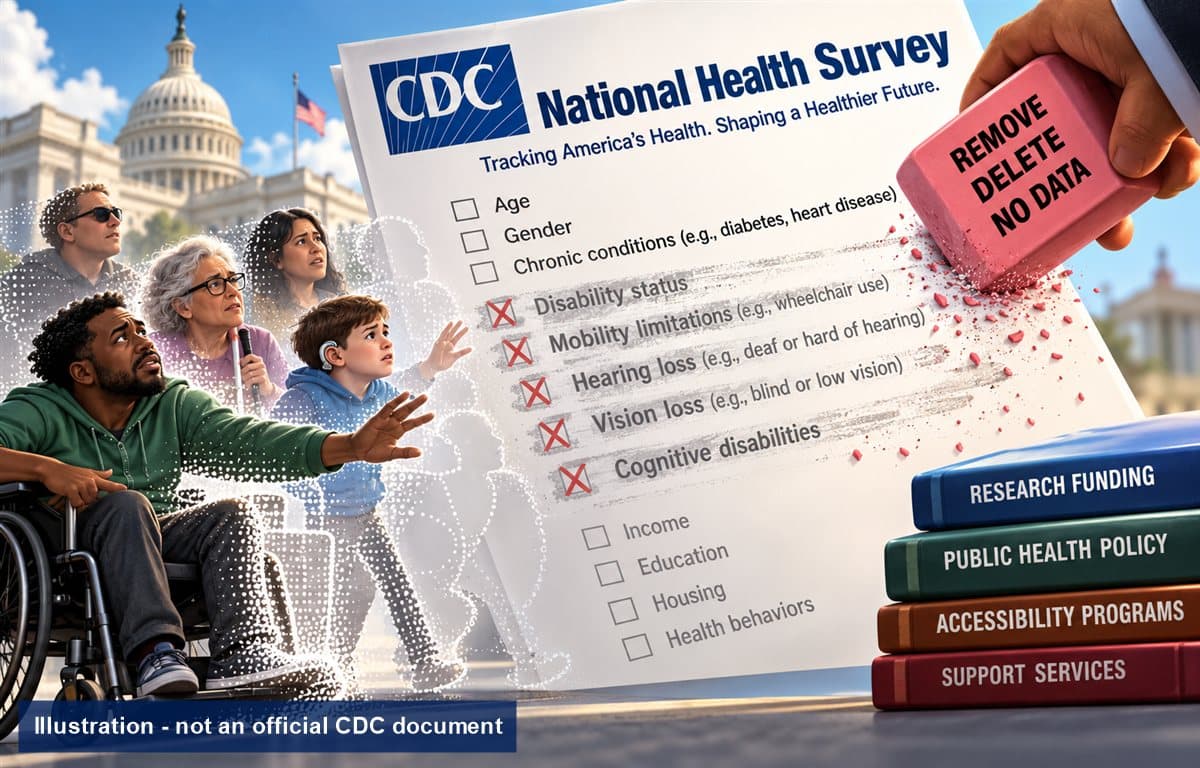
The CDC’s National Center for Health Statistics (NCHS) has proposed a 2028 NHIS redesign that would remove several disability-related questions — including those on hearing aids, fatigue, cognition, and mobility supports such as wheelchairs and scooters (Broderick, 2026). This is not a minor administrative adjustment. For a population already battling chronic undercounting and policy neglect, this decision strips away the very data infrastructure needed to justify resources, accommodations, and care. Without this data, policymakers cannot determine how many wheelchair-accessible ramps are needed in public libraries, how many children require hearing aids through Medicaid, or how to allocate assistive technology funding.
When disability disappears from national data, it disappears from policy, from budgets, and from the digital health tools designed to serve us all.
A Regression Worthy of the History Books
In terms of public health retrogression, this decision ranks alongside discouraging childhood vaccination — except with less drama and even less logic. At least vaccine skeptics have the courtesy to be loud about it. This policy quietly erases millions of people with the bureaucratic efficiency of a shredder and the public health foresight of a goldfish.
Digital Health Spin Perspective: No Data, No Innovation, No Equity
Data is the lifeblood of every effective public health intervention — and the backbone of every meaningful digital health tool. When disability data disappears from national surveys, it signals to venture capitalists and digital health entrepreneurs that there is no market to serve. And in a sector where profit margins and market share drive product roadmaps, that signal is fatal for accessibility innovation. Most digital health tools will simply not build for a population that doesn’t statistically exist in the data.
But some public good cannot be monetized. How do you put a dollar value on a blind child completing a law degree? Or an auditory-impaired child becoming the next Beethoven? The collective benefit of empowering disabled Americans to live to their full potential is a public good that enriches all of us — and it begins with the dignity of being counted.
Some public health goods cannot be monetized — the collective benefit of empowering disabled Americans to live fully is one we all share.
The Bottom Line: If You Can’t See a Population, You Can’t Serve Them
No data means no ramps, no hearing aids, no policy, no help. The public comment period for this redesign remains open until October 20, 2026 (ACL, 2026). The disability community — and everyone who cares about evidence-based healthcare — should make their voices heard before the data disappears.
Enjoyed this? Get digital health insights, sans hype.
Our free newsletter lands in your inbox every two weeks with evidence-based analysis for clinicians and health leaders.
Join the conversation: LinkedIn group · X · Facebook
References
- ACL. (2026, September 17). NCHS seeks input on 2028 National Health Interview Survey redesign. Administration for Community Living. https://acl.gov/news-and-events/announcements/nchs-seeks-input-2028-national-health-interview-survey-redesign
- Broderick, O. R. (2026, October 1). CDC health survey redesign removes questions about disabilities. STAT News. https://www.statnews.com/2026/10/01/cdc-health-survey-redesign-removes-questions-about-disabilities/
- CDC. (2023). Disability impacts all of us. Centers for Disease Control and Prevention. https://www.cdc.gov/disability-and-health/articles-documents/disability-impacts-all-of-us-infographic.html
- CDC/NCHS. (2024). National Health Interview Survey. Centers for Disease Control and Prevention. https://www.cdc.gov/nchs/nhis/index.htm
- Okoro, C. A., Hollis, N. D., Cyrus, A. C., & Griffin-Blake, S. (2018). Prevalence of disabilities and health care access by disability status and type among adults — United States, 2016. MMWR Morbidity and Mortality Weekly Report, 67(32), 882–887. https://doi.org/10.15585/mmwr.mm6732a3
- Otokiti, A. U., Farrelly, C. M., Warsame, L., & Li, A. (2022). Using a machine learning algorithm to predict online patient portal utilization: A patient engagement study. Online Journal of Public Health Informatics, 14(1), e8. https://pmc.ncbi.nlm.nih.gov/articles/PMC9831291/