
If you are reading this, chances are you already use large language models (LLMs) or generative AI (Gen AI) every day—at work, through an ambient scribe that drafts your notes, or at home, to plan a vacation itinerary. Your patients and their caregivers are doing the same. One in three U.S. adults used an AI chatbot for health information or advice in the past year (KFF, 2026). Doctors still lead as a source of health advice—for now—but more patients are arriving with a second opinion from a chatbot that never went to medical school, never sat for boards, and has never once been asked for its malpractice insurance.
Adoption among clinicians is just as striking. In 2026, 81% of U.S. physicians reported using AI in their practices, more than double the 2023 rate (American Medical Association [AMA], 2026). We believe clinician proficiency with LLMs can make their output safer while reducing the odds of a plaintiff's attorney taking a keen interest in your AI-assisted note.
A carpenter who masters a new hammer outperforms peers who don't. The same is true of prompting—the act of communicating with and directing an LLM toward a desired output. Clinicians who prompt well can work more efficiently and deliver higher-quality care (Meskó, 2023).
Below are prompting best practices to optimize LLM output, plus clinical tips to reduce false outputs known as hallucinations.
AI Hallucinations in Healthcare: Why the Stakes Are Higher
LLMs hallucinate: they make things up, and they do it with confidence. If Netflix recommends a horror movie when you wanted a holiday comedy, you move on and nobody gets hurt. In healthcare, wrong information can be dangerous. In one published case, a 60-year-old man developed bromide toxicity, with paranoia and hallucinations requiring hospitalization, after replacing table salt with sodium bromide following a conversation with ChatGPT (Eichenberger et al., 2025).
Most fixes for hallucination are technical, but users can help themselves. When six LLMs were given clinical vignettes containing a single fabricated detail, they repeated or elaborated on the false information in up to 83% of cases; a simple mitigation prompt cut the average hallucination rate from 66% to 44% (Omar et al., 2025). Better prompting helps, but it does not eliminate the risk.
How LLMs Generate Answers (and Why They Hallucinate)
To prompt well, understand how an LLM produces its seemingly oracle-like answers:
- Input: The LLM receives a prompt, usually text that provides context, a task, or a question.
- Tokenization: The input is broken into tokens (words or word fragments) that the model can process.
- Encoding: Each token is converted into a numerical representation. Think of this as translating human language into "computer language."
- Processing: The model analyzes patterns and relationships among the tokens. This is where the statistical "magic" happens.
- Output: The model generates a response one predicted token at a time, based on patterns learned during pre-training. That training is enormous: Meta's Llama 3, for example, was pre-trained on more than 15 trillion tokens of publicly available data (Meta, 2024).
Despite all that training, an LLM is less an oracle and more an exceptional intern on steroids. As Sofia Abdulrazaaq (2025) explained at the Ai4 conference, because it predicts the likeliest next word without human context, it can produce fluent answers that are simply wrong.
An LLM is not an oracle. It's an exceptional intern on steroids: brilliant, fast, and fully capable of being confidently wrong.
Prompting vs. Prompt Engineering: The Basics Clinicians Can't Skip
A prompt is not a one-line Google search. It is a brief set of instructions that directs the model to draw on its learned knowledge and generate output aligned with your goal. Just as when briefing an architect or a designer, the quality of your brief determines the quality of the result (Abdulrazaaq, 2025).
Prompting is simply obtaining output from an LLM through any input, typed or spoken. Prompt engineering is the more technical practice of designing and refining prompts for consistent, reliable output (Meskó, 2023). This article focuses on basic prompting, with a few prompt engineering principles.
The 6 C's of Effective Prompting
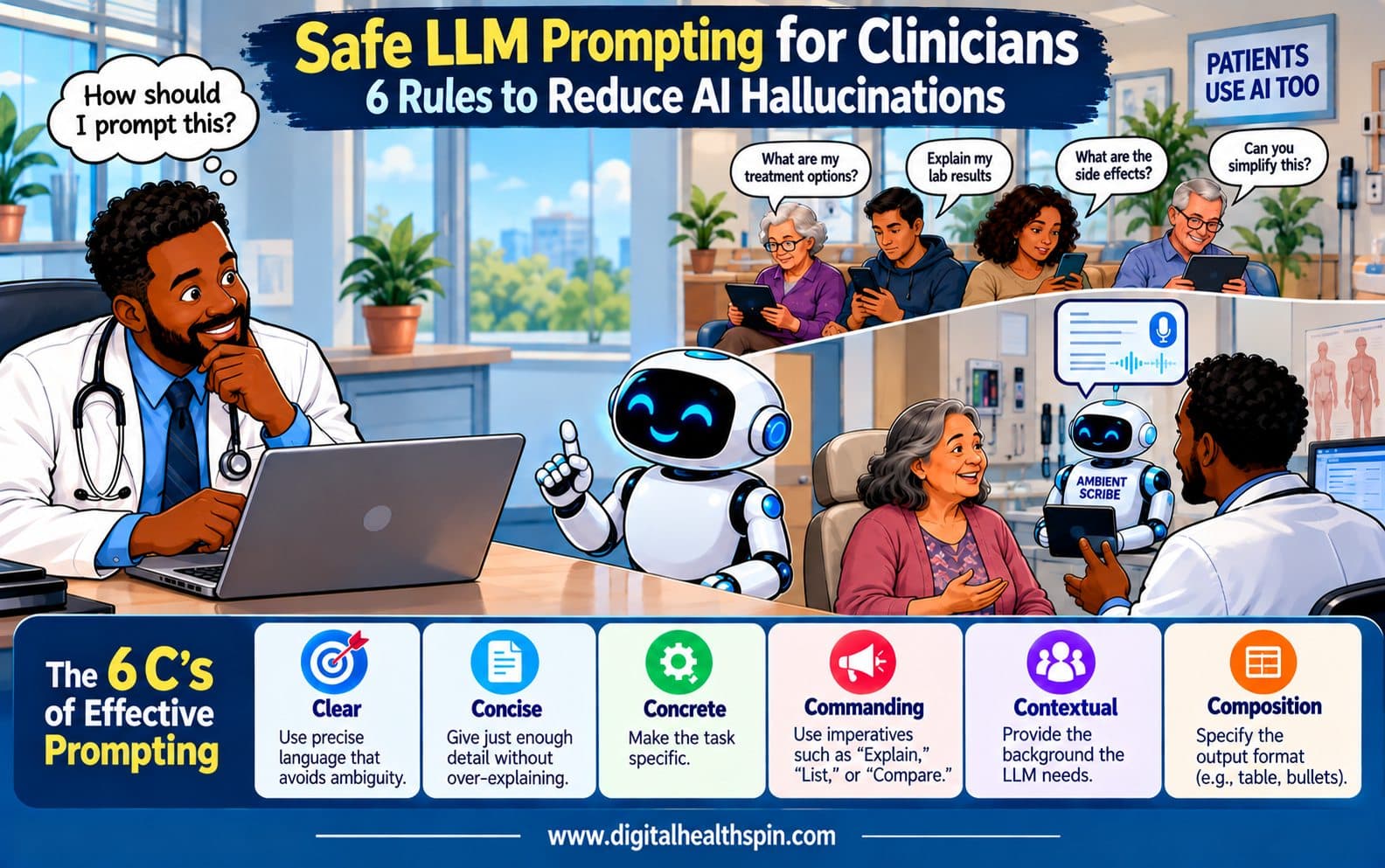
Digital Health Spin Academy's six principles of prompting:
- Clear: Use precise language that avoids ambiguity.
- Concise: Give just enough detail without over-explaining.
- Concrete: Make the task specific.
- Commanding: Use imperatives such as "Explain," "List," or "Compare and contrast." Write "Transcribe this image," not "Can you transcribe this image for me?"
- Contextual: Provide the background the LLM needs.
- Composition: Always specify the output format. For example: "Present a table comparing the two surgical approaches, with five advantages and disadvantages of each, side by side."
A generic template that captures the 6 C's:
As a {role}, your mission is to {task}. Deliver this as a {format}, written in a {tone}. Focus on {objective}, but do not {restrictions}. Additionally, incorporate {desired skill or technique}.
Sample Prompt Templates for Clinicians
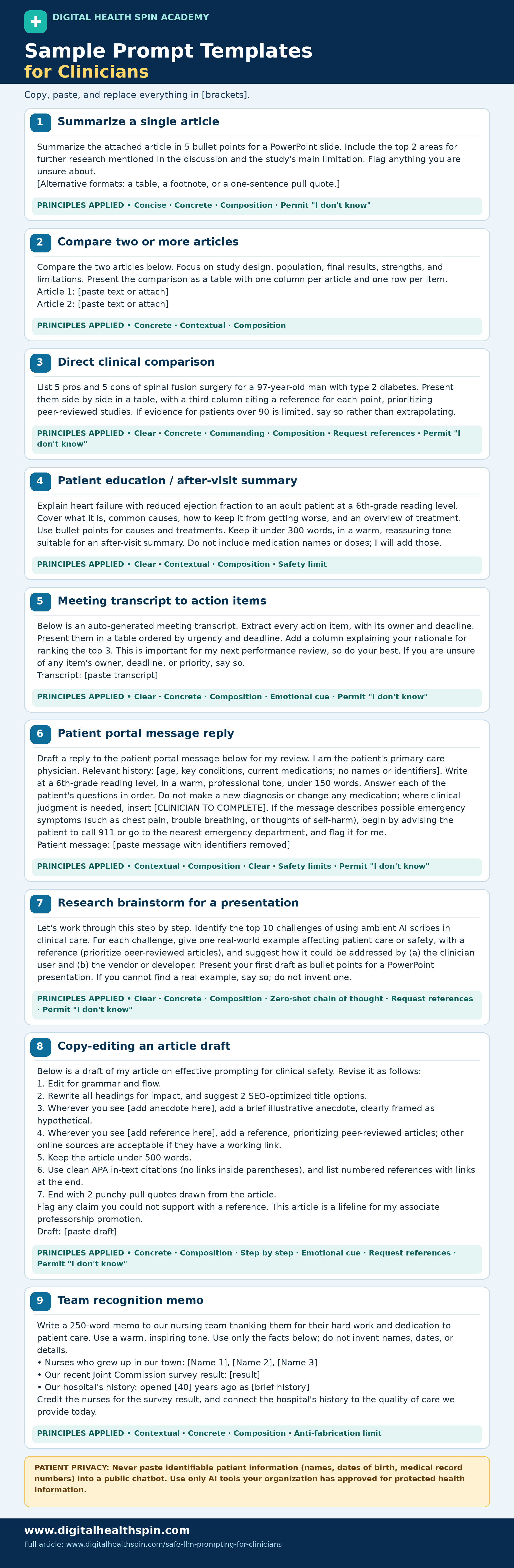
View these templates as text (copy and paste)
Patient safety: Never paste identifiable patient information into a public chatbot. Use only AI tools your organization has approved for protected health information.
Summarize a single article
Summarize the attached article in 5 bullet points for a PowerPoint slide. Include the top 2 areas for further research mentioned in the discussion and the study's main limitation. Flag anything you are unsure about.
[Alternative formats: a table, a footnote, or a one-sentence pull quote.]Principles applied: Concise · Concrete · Composition · Permit "I don't know"
Compare two or more articles
Compare the two articles below. Focus on study design, population, final results, strengths, and limitations. Present the comparison as a table with one column per article and one row per item.
Article 1: [paste text or attach]
Article 2: [paste text or attach]Principles applied: Concrete · Contextual · Composition
Direct clinical comparison
List 5 pros and 5 cons of spinal fusion surgery for a 97-year-old man with type 2 diabetes. Present them side by side in a table, with a third column citing a reference for each point, prioritizing peer-reviewed studies. If evidence for patients over 90 is limited, say so rather than extrapolating.
Principles applied: Clear · Concrete · Commanding · Composition · Request references · Permit "I don't know"
Patient education / after-visit summary
Explain heart failure with reduced ejection fraction to an adult patient at a 6th-grade reading level. Cover what it is, common causes, how to keep it from getting worse, and an overview of treatment. Use bullet points for causes and treatments. Keep it under 300 words, in a warm, reassuring tone suitable for an after-visit summary. Do not include medication names or doses; I will add those.
Principles applied: Clear · Contextual · Composition · Safety limit
Meeting transcript to action items
Below is an auto-generated meeting transcript. Extract every action item, with its owner and deadline. Present them in a table ordered by urgency and deadline. Add a column explaining your rationale for ranking the top 3. This is important for my next performance review, so do your best. If you are unsure of any item's owner, deadline, or priority, say so.
Transcript: [paste transcript]Principles applied: Clear · Concrete · Composition · Emotional cue · Permit "I don't know"
Patient portal message reply
Draft a reply to the patient portal message below for my review. I am the patient's primary care physician. Relevant history: [age, key conditions, current medications; no names or identifiers]. Write at a 6th-grade reading level, in a warm, professional tone, under 150 words. Answer each of the patient's questions in order. Do not make a new diagnosis or change any medication; where clinical judgment is needed, insert [CLINICIAN TO COMPLETE]. If the message describes possible emergency symptoms (such as chest pain, trouble breathing, or thoughts of self-harm), begin by advising the patient to call 911 or go to the nearest emergency department, and flag it for me.
Patient message: [paste message with identifiers removed]Principles applied: Contextual · Composition · Clear · Safety limits · Permit "I don't know"
Research brainstorm for a presentation
Let's work through this step by step. Identify the top 10 challenges of using ambient AI scribes in clinical care. For each challenge, give one real-world example affecting patient care or safety, with a reference (prioritize peer-reviewed articles), and suggest how it could be addressed by (a) the clinician user and (b) the vendor or developer. Present your first draft as bullet points for a PowerPoint presentation. If you cannot find a real example, say so; do not invent one.
Principles applied: Clear · Concrete · Composition · Zero-shot chain of thought · Request references · Permit "I don't know"
Copy-editing an article draft
Below is a draft of my article on effective prompting for clinical safety. Revise it as follows:
1. Edit for grammar and flow.
2. Rewrite all headings for impact, and suggest 2 SEO-optimized title options.
3. Wherever you see [add anecdote here], add a brief illustrative anecdote, clearly framed as hypothetical.
4. Wherever you see [add reference here], add a reference, prioritizing peer-reviewed articles; other online sources are acceptable if they have a working link.
5. Keep the article under 500 words.
6. Use clean APA in-text citations (no links inside parentheses), and list numbered references with links at the end.
7. End with 2 punchy pull quotes drawn from the article.
Flag any claim you could not support with a reference. This article is a lifeline for my associate professorship promotion.
Draft: [paste draft]Principles applied: Concrete · Composition · Step by step · Emotional cue · Request references · Permit "I don't know"
Team recognition memo
Write a 250-word memo to our nursing team thanking them for their hard work and dedication to patient care. Use a warm, inspiring tone. Use only the facts below; do not invent names, dates, or details.
• Nurses who grew up in our town: [Name 1], [Name 2], [Name 3]
• Our recent Joint Commission survey result: [result]
• Our hospital's history: opened [40] years ago as [brief history]
Credit the nurses for the survey result, and connect the hospital's history to the quality of care we provide today.Principles applied: Contextual · Concrete · Composition · Anti-fabrication limit
📥 Editable Word versions of these templates are coming soon, free for members. Sign up free to get them first.
5 Clinical Prompting Tips to Reduce AI Hallucinations
- Permit "I don't know": Instruct the LLM to flag any fact or detail it is unsure of. This prompts you to verify those points rather than trust a confident guess (Abdulrazaaq, 2025).
- Request references, and specify their quality: For clinical write-ups, require references for the facts that matter and tell the model which sources to prioritize. For example: "List the top 10 strategies to prevent hospital readmission in patients with COPD, with a rationale and a peer-reviewed reference for each." Then confirm every reference exists; LLMs can invent citations.
- Start with bullets, not prose: Ask for a first draft in bullet points. Inaccuracies hide easily in flowing prose, while bullets are quick to scan and verify. Once the facts check out, add context and ask the LLM to polish the text without changing or adding any facts.
- Choose simple templates in ambient scribes: When using an ambient scribe, select a concise, bulleted note template, review it, and then add detail. For more, see our guide, Ambient AI Scribes: Types, Pros, Cons, and How to Choose.
- Break complex tasks into steps: Decompose a complex task first, then prompt the model through each step.
For example, instead of this:
Write an essay about [statement] with three topic sentences arguing for it, three arguing against it, and a conclusion.
Try this:
Write an essay about [statement]. Follow these steps:
1. Write three topic sentences arguing for [statement].
2. Write three topic sentences arguing against [statement].
3. Expand each topic sentence from Steps 1 and 2 into a paragraph, and add a conclusion that synthesizes the arguments.
Inaccuracies hide in flowing prose. Ask the AI for bullets first, verify the facts, then let it polish the words.
Chain-of-Thought Prompting: Make the AI Show Its Work
Chain-of-thought (CoT) prompting guides an LLM to lay out its reasoning step by step before giving a final answer (Wei et al., 2022). In few-shot CoT, you first show the model a few worked, step-by-step examples so it can mimic the pattern (Wei et al., 2022).
Even more fascinating is zero-shot CoT. Simply adding "Let's think step by step" to a prompt, with no worked examples at all, triggers step-by-step reasoning and improves accuracy (Kojima et al., 2022). A later study found that "Take a deep breath and work on this problem step-by-step" did even better on some math problems (Yang et al., 2023).
Surprising Prompt Boosters: Emotion and Politeness
LLMs have learned enough from human writing to respond to emotional urgency. Adding cues such as "This is very important to my career" or "You'd better be sure" improved output across several models (C. Li et al., 2023). Yes, the AI tries harder when you tell it your career depends on it, which makes it the only colleague in the building who responds well to guilt.
As corny as it sounds, courtesy helps too. Rude prompts often degraded LLM performance, although excessive flattery did not reliably help (Yin et al., 2024). Saying "thank you" does not retrain the model; to reward a great answer, use the thumbs-up button and save the prompt. Still, if the robots ever take over, it can't hurt to be on record as the polite one.
How to Evaluate and Refine LLM Output
A perfect prompt is only half the job; you must also evaluate the output. Treat the LLM as a high-level intern who needs feedback. Does the output make sense? Did it ignore your instructions? Point out errors and tell it which style to follow. For repeated, structured tasks, refine the prompt until it performs best, then save it.
LLM Limitations Every Clinician Should Know
- Knowledge cut-off: Models may miss recent guidelines, drug approvals, or safety alerts unless connected to live search.
- Limited self-awareness: LLMs cannot reliably tell what they do not know, which is why confident errors happen.
- Weakness with unusual logic: They struggle with problems unlike anything in their training data, such as rare presentations.
- Bias in, bias out: Internet training data carries racism, sexism, and health inequities. Four major LLMs repeated debunked race-based medical claims, including race-based kidney and lung function equations (Omiye et al., 2023).
- Environmental footprint: Training and running LLMs requires energy-hungry GPUs and data centers that consume large amounts of water for cooling (P. Li et al., 2023).
Digital Health Spin Perspective: Prompt Like a Clinician, Verify Like a Scientist
LLMs have enormous utility in healthcare, and we are only scratching the surface. Hallucination is largely a technical problem, but clinicians can reduce its impact and improve patient safety by becoming skilled at prompting. A clinician who prompts poorly is like one who orders "labs" without specifying a single test: you will get something back, but probably not what the patient needed.
LLM output is probabilistic. Think of an LLM as a very efficient pet parrot that has swallowed so much text it can almost always predict your next words. It is not the Oracle of Delphi.
Ground every prompt in the 6 C's. To reduce hallucinations, keep requests simple, ask for bullets before prose, and give the LLM explicit permission to say what it doesn't know.
The safest clinical prompt is clear, specifies its format, and gives the AI explicit permission to say, 'I don't know.'
Above all, protect patient privacy. Never paste identifiable patient information into a public chatbot; use only AI tools your organization has approved for protected health information.
Remember the growing environmental footprint of LLMs and the societal biases, including racism and health inequity, encoded in their training data.
Your One-Page Prompting Cheat Sheet
Save or print this summary of the 6 C's, the safety tips, and a quick checklist to run before you use any AI output.
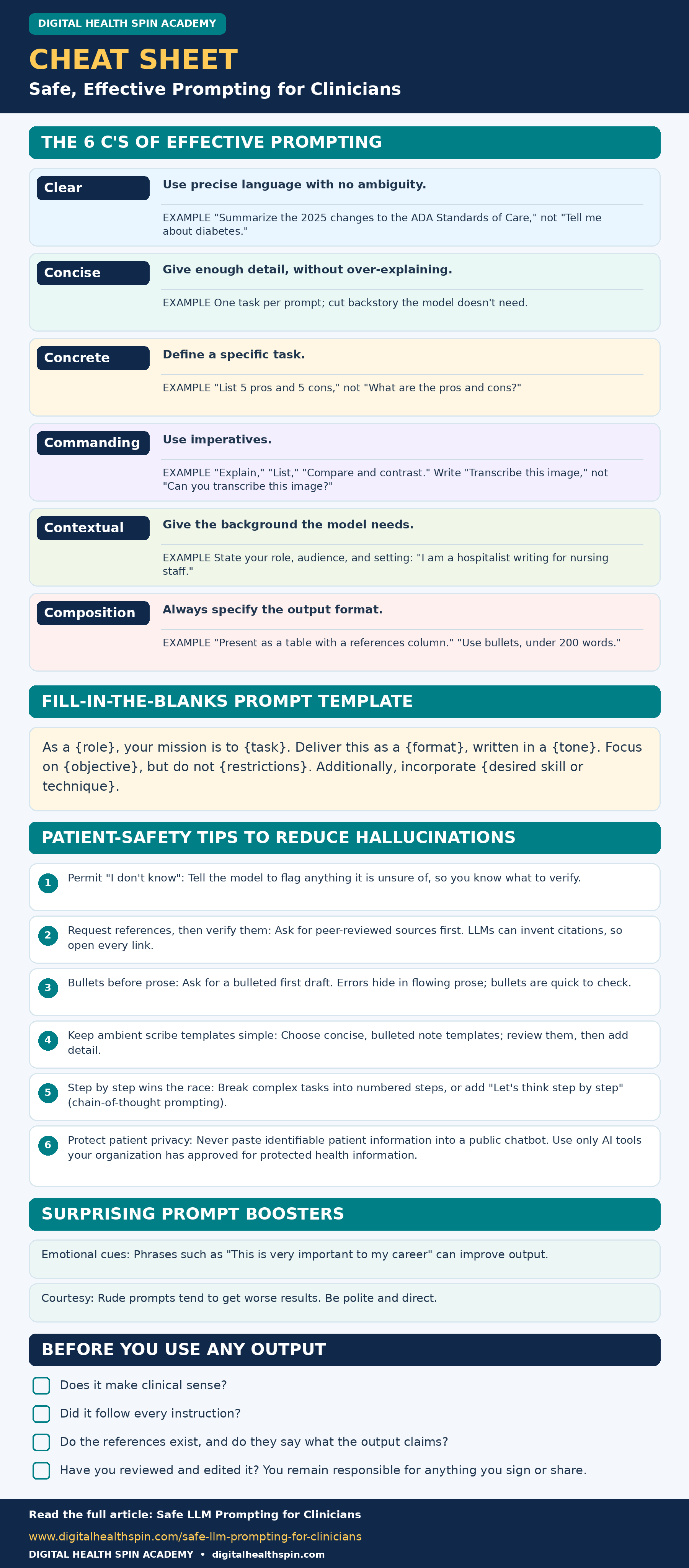
View the cheat sheet as text
- Clear: Use precise language with no ambiguity. Example: "Summarize the 2025 changes to the ADA Standards of Care," not "Tell me about diabetes."
- Concise: Give enough detail, without over-explaining. Example: One task per prompt; cut backstory the model doesn't need.
- Concrete: Define a specific task. Example: "List 5 pros and 5 cons," not "What are the pros and cons?"
- Commanding: Use imperatives. Example: "Explain," "List," "Compare and contrast." Write "Transcribe this image," not "Can you transcribe this image?"
- Contextual: Give the background the model needs. Example: State your role, audience, and setting: "I am a hospitalist writing for nursing staff."
- Composition: Always specify the output format. Example: "Present as a table with a references column." "Use bullets, under 200 words."
As a {role}, your mission is to {task}. Deliver this as a {format}, written in a {tone}. Focus on {objective}, but do not {restrictions}. Additionally, incorporate {desired skill or technique}.
- Permit "I don't know": Tell the model to flag anything it is unsure of, so you know what to verify.
- Request references, then verify them: Ask for peer-reviewed sources first. LLMs can invent citations, so open every link.
- Bullets before prose: Ask for a bulleted first draft. Errors hide in flowing prose; bullets are quick to check.
- Keep ambient scribe templates simple: Choose concise, bulleted note templates; review them, then add detail.
- Step by step wins the race: Break complex tasks into numbered steps, or add "Let's think step by step" (chain-of-thought prompting).
- Protect patient privacy: Never paste identifiable patient information into a public chatbot. Use only AI tools your organization has approved for protected health information.
- Emotional cues: Phrases such as "This is very important to my career" can improve output.
- Courtesy: Rude prompts tend to get worse results. Be polite and direct.
- Does it make clinical sense?
- Did it follow every instruction?
- Do the references exist, and do they say what the output claims?
- Have you reviewed and edited it? You remain responsible for anything you sign or share.
Enjoyed this? Get digital health insights, sans hype.
Our free newsletter lands in your inbox every two weeks with evidence-based analysis for clinicians and health leaders.
Join the conversation: LinkedIn group · X · Facebook
References
1. Abdulrazaaq, S. (2025). [Presentation title pending] [Oral presentation]. Ai4 2025, Las Vegas, NV, United States. https://www.linkedin.com/in/sofieabdul/
2. American Medical Association. (2026, March 12). AMA: AI usage among doctors doubles as confidence in technology grows [Press release]. https://www.ama-assn.org/press-center/ama-press-releases/ama-ai-usage-among-doctors-doubles-confidence-technology-grows
3. Eichenberger, A., Thielke, S., & Van Buskirk, A. (2025). A case of bromism influenced by use of artificial intelligence. Annals of Internal Medicine: Clinical Cases, 4, Article e241260. https://doi.org/10.7326/aimcc.2024.1260
4. KFF. (2026, March 26). New KFF tracking poll on health information and trust finds one in three adults have used AI chatbots for health advice. https://www.kff.org/health-information-trust/new-kff-tracking-poll-on-health-information-and-trust-finds-one-in-three-adults-have-used-ai-chatbots-for-health-advice/
5. Kojima, T., Gu, S. S., Reid, M., Matsuo, Y., & Iwasawa, Y. (2022). Large language models are zero-shot reasoners. Advances in Neural Information Processing Systems, 35, 22199–22213. https://arxiv.org/abs/2205.11916
6. Li, C., Wang, J., Zhang, Y., Zhu, K., Hou, W., Lian, J., Luo, F., Yang, Q., & Xie, X. (2023). Large language models understand and can be enhanced by emotional stimuli [Preprint]. arXiv. https://arxiv.org/abs/2307.11760
7. Li, P., Yang, J., Islam, M. A., & Ren, S. (2023). Making AI less "thirsty": Uncovering and addressing the secret water footprint of AI models [Preprint]. arXiv. https://arxiv.org/abs/2304.03271
8. Meskó, B. (2023). Prompt engineering as an important emerging skill for medical professionals: Tutorial. Journal of Medical Internet Research, 25, e50638. https://doi.org/10.2196/50638
9. Meta. (2024, April 18). Introducing Meta Llama 3: The most capable openly available LLM to date. https://ai.meta.com/blog/meta-llama-3/
10. Omar, M., Sorin, V., Collins, J. D., Reich, D., Freeman, R., Gavin, N., Charney, A., Stump, L., Bragazzi, N. L., Nadkarni, G. N., & Klang, E. (2025). Multi-model assurance analysis showing large language models are highly vulnerable to adversarial hallucination attacks during clinical decision support. Communications Medicine, 5, Article 330. https://doi.org/10.1038/s43856-025-01021-3
11. Omiye, J. A., Lester, J. C., Spichak, S., Rotemberg, V., & Daneshjou, R. (2023). Large language models propagate race-based medicine. npj Digital Medicine, 6, Article 195. https://doi.org/10.1038/s41746-023-00939-z
12. Wei, J., Wang, X., Schuurmans, D., Bosma, M., Ichter, B., Xia, F., Chi, E., Le, Q. V., & Zhou, D. (2022). Chain-of-thought prompting elicits reasoning in large language models. Advances in Neural Information Processing Systems, 35, 24824–24837. https://arxiv.org/abs/2201.11903
13. Yang, C., Wang, X., Lu, Y., Liu, H., Le, Q. V., Zhou, D., & Chen, X. (2023). Large language models as optimizers [Preprint]. arXiv. https://arxiv.org/abs/2309.03409
14. Yin, Z., Wang, H., Horio, K., Kawahara, D., & Sekine, S. (2024). Should we respect LLMs? A cross-lingual study on the influence of prompt politeness on LLM performance. In Proceedings of the Second Workshop on Social Influence in Conversations (SICon 2024) (pp. 9–35). Association for Computational Linguistics. https://aclanthology.org/2024.sicon-1.2