
From IBM Watson to Ambient Scribes: Big Promises, Mixed Results
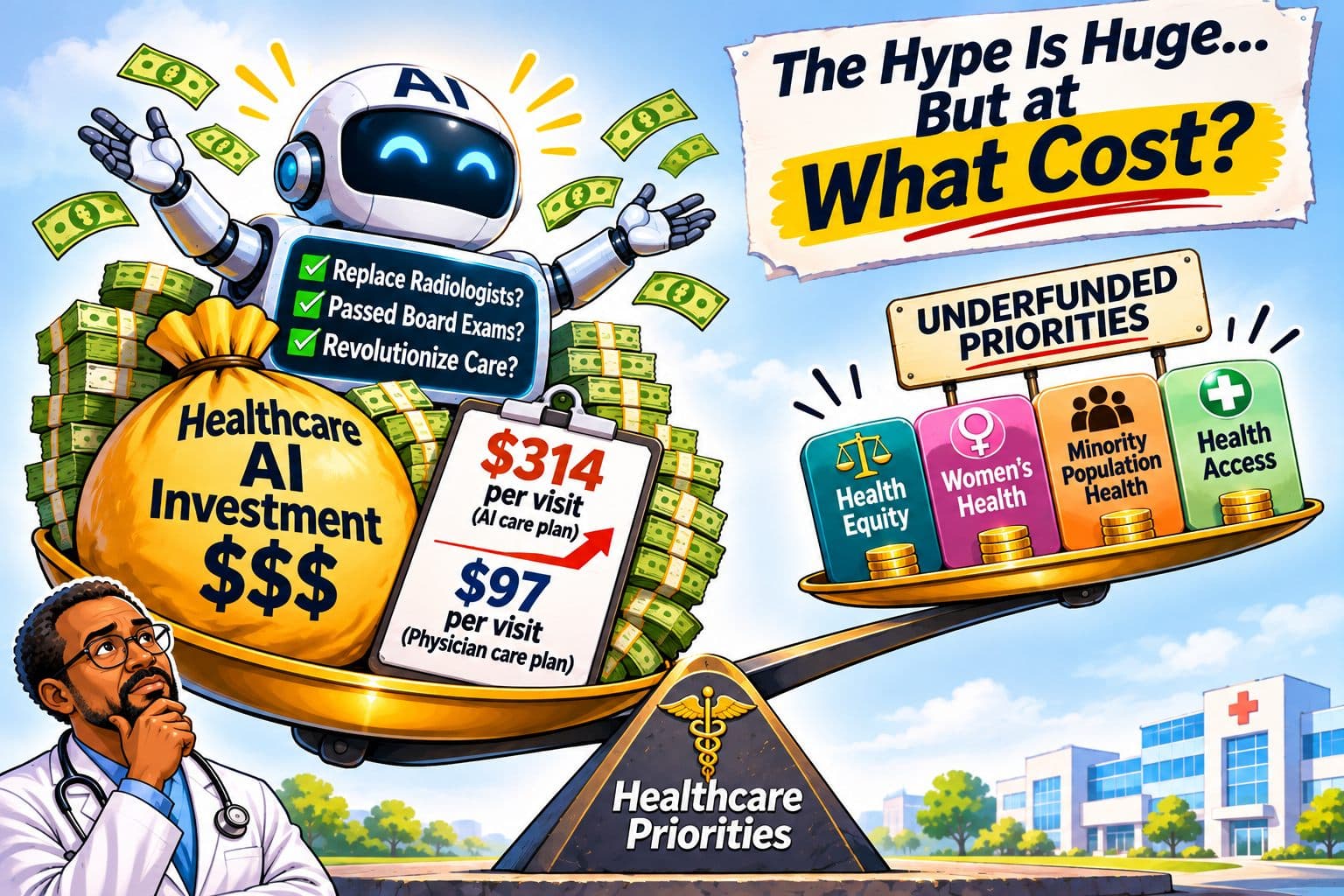
By now, you have heard the predictions that AI will replace radiologists and the headlines about AI passing medical board exams. The hype predates large language models (LLMs). IBM Watson was marketed as the tool that would revolutionize cancer care, yet it struggled to deliver reliable treatment recommendations (Ross & Swetlitz, 2017). Watson underachieved so badly that IBM eventually sold its Watson Health assets for parts ("Merative, a New Data Company," 2022).
Fast forward to today: radiologists have not been replaced. In 2016, AI pioneer Geoffrey Hinton called it "just completely obvious" that AI would soon make them extinct. Instead, the field faces a workforce shortage, and Mayo Clinic's radiologist headcount has grown 55% since that prediction, even as it adopted hundreds of AI models (Loizos, 2025).
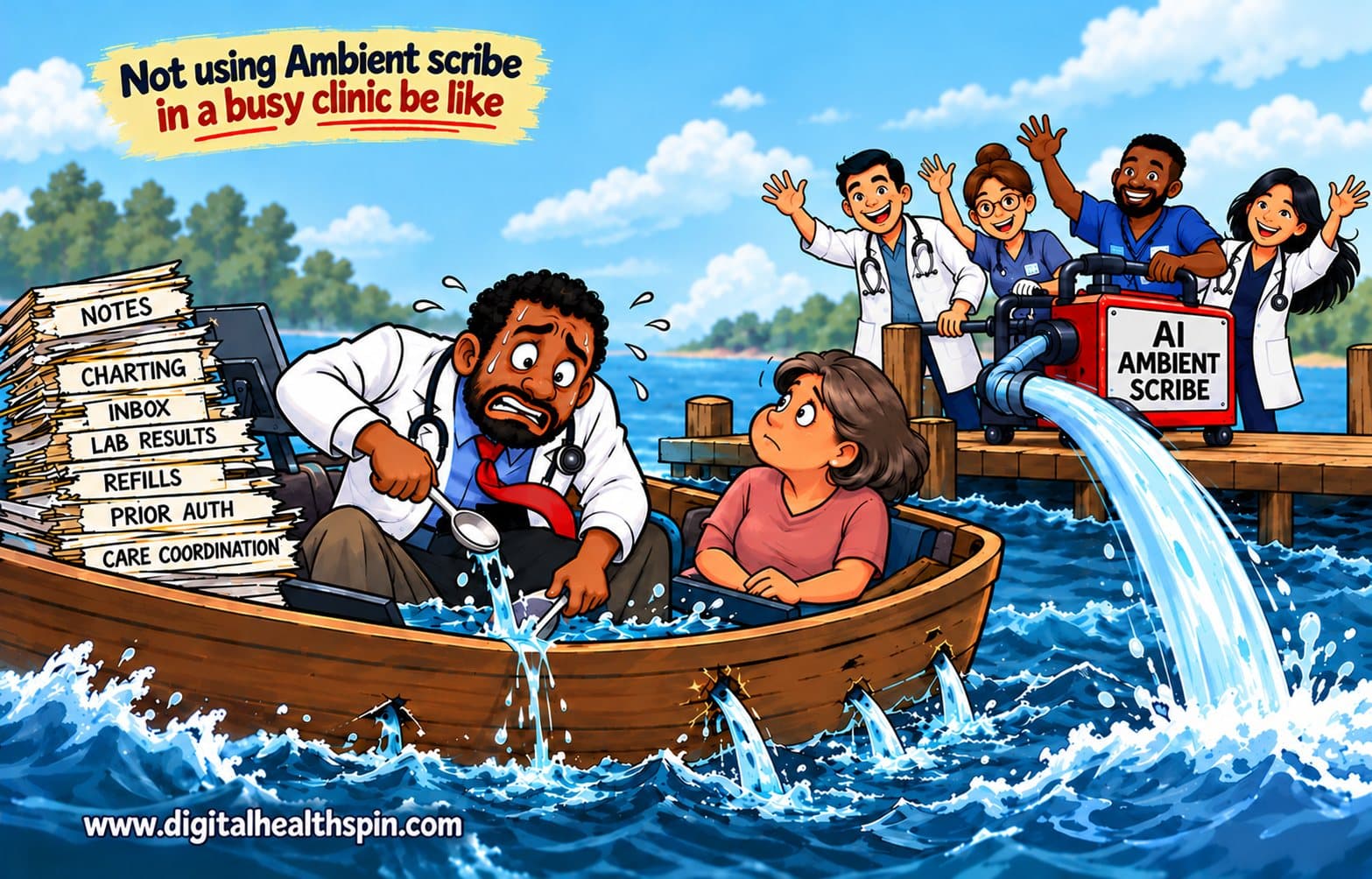
So far, the most promising AI in direct patient care appears to be the ambient scribe, which has saved clinicians documentation time in randomized and multisite studies (Lukac et al., 2025; Rotenstein et al., 2026). Yet these tools remain too expensive for many smaller practices and underserved clinics. Our revolution is becoming one-sided, like a potluck where only the hospitals with the biggest kitchens get to eat.
So why are radiologists still in high demand? Below, we answer that question, unpack the obvious and "drowned" costs of AI, and share evidence-based ways to avoid wasting money on AI.
The real question isn't whether AI can revolutionize healthcare. It's whether AI can deliver better outcomes without multiplying costs.
What the NEJM AI Study and Soaring Token Bills Reveal
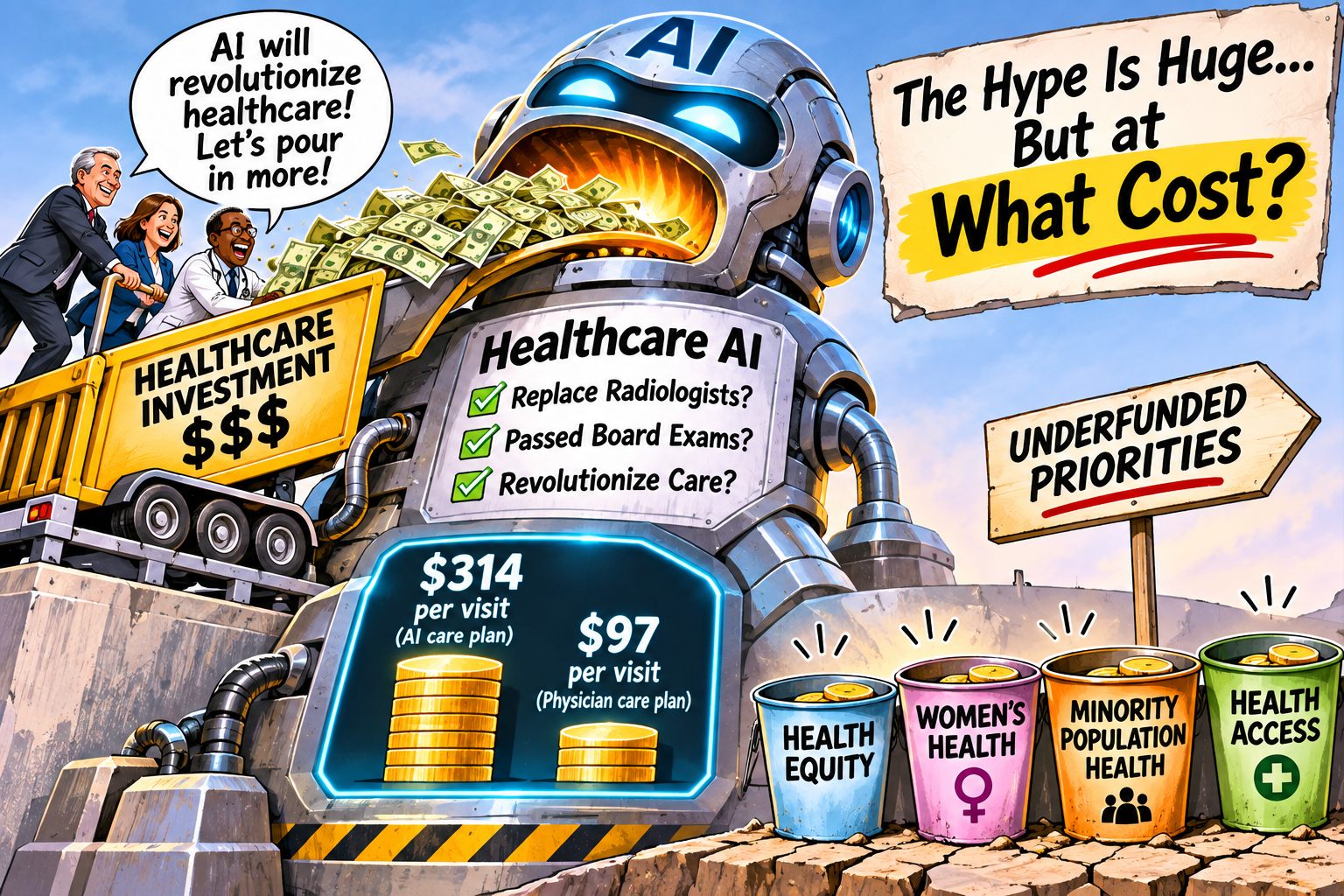
The hype is endless. But what about the economics? In a recent NEJM AI study, care plans recommended by 20 large language models cost a mean of $314 per visit, versus $97 for the plans documented by treating physicians: more than three times as much (Aran et al., 2026).
Meanwhile, AI token consumption is skyrocketing. A token is the basic unit of text an AI model reads or writes, roughly three-quarters of a word. Vendors bill by the token, so every prompt and answer has a price. Measurable business value, however, is lagging. Uber burned through its entire 2026 AI budget in four months as its engineers embraced Claude Code, leading its chief operating officer to question whether the spending was worth it ("Uber Burned Through," 2026).
Other examples are more dramatic. One company reportedly spent about $500 million on Claude in a single month after failing to cap employee usage ("AI Sticker Shock," 2026). The creator of the OpenClaw AI assistant ran up roughly $1.3 million in OpenAI charges in 30 days, covering 603 billion tokens, showing how quickly costs spiral when usage goes unchecked ("OpenClaw Creator," 2026).
So go easy on those AI-generated portraits of your cat as a Renaissance duke. Somewhere, a data center is sweating for Sir Whiskers.
Don't Blame the AI: It Learned Our Expensive Habits
Still, we at Digital Health Spin Academy believe AI can improve health and lower costs when applied to the right use case. So don't shoot the messenger; blame the system feeding it.
Defensive medicine, unnecessary testing, billing incentives that reward upcoding, and years of bloated clinical documentation are baked into the data in our electronic health records (EHRs). U.S. clinical notes are nearly four times longer than those in other countries, largely to satisfy billing and regulatory demands (Downing et al., 2018). Train AI on that data, and you get our expensive habits on steroids. When one widely used algorithm learned from healthcare spending data, it also learned the system's racial bias and underestimated the needs of Black patients (Obermeyer et al., 2019). AI is merely holding up a mirror, and we trained it on our own bad habits.
AI is merely holding up a mirror. Train it on healthcare's expensive habits, and you get those habits on steroids.
The Efficiency Trap: Why AI Time Savings Create More Work
Second, efficiency gains from ambient scribes can be swallowed when administrators add patients to clinicians' schedules. A multisite JAMA study of more than 8,500 clinicians found that scribe adoption brought modest documentation savings, slightly more visits per week, and no significant drop in after-hours EHR work (Rotenstein et al., 2026). This familiar pattern is known as the Jevons paradox: when technology makes something cheaper or faster, we use more of it, not less. Cheaper AI tokens, for example, have led companies to spend more on AI overall ("Tokens Are Getting Cheaper," 2026).
The same paradox explains why radiologists remain in demand: as AI speeds up reads, more images are sent for reading. Add the rising imaging needs of an aging U.S. population, and the reasons are convincing.
Beyond the Price Tag: Environmental, Infrastructure and Equity Costs
Beyond the price tag, some costs are long-term and hard to quantify.
🌍 Environmental impact
Training GPT-3 alone used an estimated 1,287 megawatt-hours of electricity and emitted about 552 metric tons of carbon dioxide equivalent (Patterson et al., 2021). A single prompt looks harmless: Google estimates that a median Gemini text prompt uses 0.24 watt-hours of energy and about five drops of water (Google, 2025). But billions of prompts add up; one estimate suggests GPT-3 "drinks" a 500 ml bottle of water for every 10 to 50 responses (Li et al., 2023). Global data center electricity demand is projected to more than double by 2030, driven largely by AI, bringing more water-hungry cooling and greenhouse gas emissions (International Energy Agency [IEA], 2025).
💰 Implementation and infrastructure costs
Buying the tool is just the beginning. EHR integration, staff training, cybersecurity, ongoing licenses, monitoring for errors and upgrades keep adding up long after the purchase order is signed. We covered these in our article on the hidden cost of AI in healthcare.
⚖️ Health inequity and biased data
This works in two ways. First, many underserved, high-need health centers cannot afford these tools, deepening the digital divide. Second, much of the data behind these tools underrepresents people of color and people with disabilities. About 26.7 million people in the United States were uninsured for all of 2025 (U.S. Census Bureau, 2026), and their data rarely make it into EHRs, so it is largely missing from model training.
The Digital Health Spin Perspective
As a practicing U.S. physician, I am hardly surprised at how costly the AI revolution has become, and this is just the beginning. American healthcare is notoriously inefficient, wasteful and opaque. Call me when you actually understand your insurance Explanation of Benefits. Deciphering the Rosetta Stone is easier. 😅
The real question isn't whether AI can revolutionize healthcare. It's whether AI can deliver better outcomes without multiplying costs. So how do we make healthcare AI clinically and economically sustainable?
How to Prevent AI Overspending in Healthcare: 6 Practical Steps
1. Aim for small, incremental wins. Healthcare is a delicate industry; rapid overhauls belong in Terminator movies. AI is one tool in the toolbox, not the North Star, even if every new product now opens with "AI this, AI that." Implement it for gradual improvement and learn along the way.
2. Pick the low-hanging fruit first. Look for problems with high impact, low risk and manageable cost. Too many developers chase the flashiest decision support or readmission-prediction model. Predicting readmissions with expensive AI while patients still struggle to book appointments and lack social support after discharge turns that AI into an expensive toy with bragging rights.
3. Evaluate and compare tools. Before investing in any AI tool, such as an ambient scribe, compare it with similar tools on the market. Don't overinvest in this young field: today's winners may not be the champions in five years. See our guide on how to choose an ambient AI scribe.
4. Prompt efficiently. Using AI well cuts costs and improves safety. In the NEJM AI study above, a cost-aware prompt narrowed the gap between AI and physician care plans, though it did not close it (Aran et al., 2026). See our guide to safe, effective prompting for clinicians.
5. Avoid FOMO. Don't buy AI just to be one of the "cool kids." As in high school, that always gets you in trouble. Invest based on your organization's specific needs.
6. Count the hidden costs. When comparing tools, consider which one needs fewer resources to run (memory, computing power, carbon footprint and ongoing fees). Also ask whether your patients can use it: a tool that runs only on iPhones has already excluded many of them.
Need help evaluating an AI or digital health solution? Reach out to Digital Health Spin Academy at [email protected]. We help you and your healthcare organization determine whether emerging technologies are clinically appropriate, operationally feasible, financially sustainable, environmentally responsible and, ultimately, worth the investment before implementation.
Enjoyed this? Get digital health insights, sans hype.
Our free newsletter lands in your inbox every two weeks with evidence-based analysis for clinicians and health leaders.
Join the conversation: LinkedIn group · X · Facebook
In Good Health,
The Digital Health Spin Framework™
Your guide to health innovation through:
Clinical Value • Health Equity • Economic Sustainability • Environmental Sustainability
References
1. AI sticker shock hits corporate America. (2026, May 28). Axios. https://www.axios.com/2026/05/28/ai-spending-roi-enterprise-costs
2. Aran, D., Goldhaber-Fiebert, J. D., Many, I., Nguyen, A., Yang, D., & Shelly, S. (2026). Comparative cost of care recommended by large language models versus treating physicians. NEJM AI, 3(11), AIoa2600537. https://doi.org/10.1056/AIoa2600537
3. Downing, N. L., Bates, D. W., & Longhurst, C. A. (2018). Physician burnout in the electronic health record era: Are we ignoring the real cause? Annals of Internal Medicine, 169(1), 50–51. https://doi.org/10.7326/M18-0139
4. Google. (2025). Measuring the environmental impact of delivering AI at Google scale [Technical paper]. arXiv. https://arxiv.org/abs/2508.15734
5. International Energy Agency. (2025). Energy and AI. https://www.iea.org/reports/energy-and-ai
6. Li, P., Yang, J., Islam, M. A., & Ren, S. (2023). Making AI less "thirsty": Uncovering and addressing the secret water footprint of AI models. arXiv. https://arxiv.org/abs/2304.03271
7. Loizos, C. (2025, May 14). Radiologists aren't going anywhere. TechCrunch. https://techcrunch.com/2025/05/14/radiologists-arent-going-anywhere/
8. Lukac, P. J., Turner, W., Vangala, S., Chin, A. T., Khalili, J., Shih, Y. T., Sarkisian, C., Cheng, E. M., & Mafi, J. N. (2025). Ambient AI scribes in clinical practice: A randomized trial. NEJM AI, 2(12). https://doi.org/10.1056/AIoa2501000
9. Merative, a new data company, formed from IBM's healthcare analytics assets. (2022). Healthcare IT News. https://www.healthcareitnews.com/news/merative-new-data-company-formed-ibms-healthcare-analytics-assets
10. Obermeyer, Z., Powers, B., Vogeli, C., & Mullainathan, S. (2019). Dissecting racial bias in an algorithm used to manage the health of populations. Science, 366(6464), 447–453. https://doi.org/10.1126/science.aax2342
11. OpenClaw creator burned through $1.3 million in OpenAI API tokens in a single month. (2026). Tom's Hardware. https://www.tomshardware.com/tech-industry/artificial-intelligence/openclaw-creator-burns-through-1-3-million-in-openai-api-tokens-in-a-single-month
12. Patterson, D., Gonzalez, J., Le, Q., Liang, C., Munguia, L.-M., Rothchild, D., So, D., Texier, M., & Dean, J. (2021). Carbon emissions and large neural network training. arXiv. https://arxiv.org/abs/2104.10350
13. Ross, C., & Swetlitz, I. (2017, September 5). IBM pitched its Watson supercomputer as a revolution in cancer care. It's nowhere close. STAT. https://www.statnews.com/2017/09/05/watson-ibm-cancer/
14. Rotenstein, L. S., Holmgren, A. J., Thombley, R., Sriram, A., Dbouk, R. H., Jost, M., Aizenberg, D., MacDonald, S., Kanaparthy, N., Williams, B., Hsiao, A., Schwamm, L., Murray, S., Byron, M., You, J. G., Centi, A. J., Iannaccone, C., Frits, M., Landman, A. B., . . . Mishuris, R. G. (2026). Changes in clinician time expenditure and visit quantity with adoption of artificial intelligence-powered scribes: A multisite study. JAMA, 335(16), 1408–1417. https://doi.org/10.1001/jama.2026.2253
15. Tokens are getting cheaper, but companies are spending even more on AI as a result, top economist warns. (2026, June 17). Fortune. https://fortune.com/2026/06/17/why-is-ai-spending-increasing-as-tokens-get-cheaper-jevons-paradox/
16. Uber burned through its entire 2026 AI budget in four months. Now its COO is questioning whether it's worth it. (2026, May 26). Fortune. https://fortune.com/2026/05/26/uber-coo-ai-spending-tokens-claude-code/
17. U.S. Census Bureau. (2026). Health insurance coverage in the United States: 2025. https://www.census.gov/library/publications/2026/demo/p60-291.html