
What Is HIPAA? A Quick Primer for the AI Era
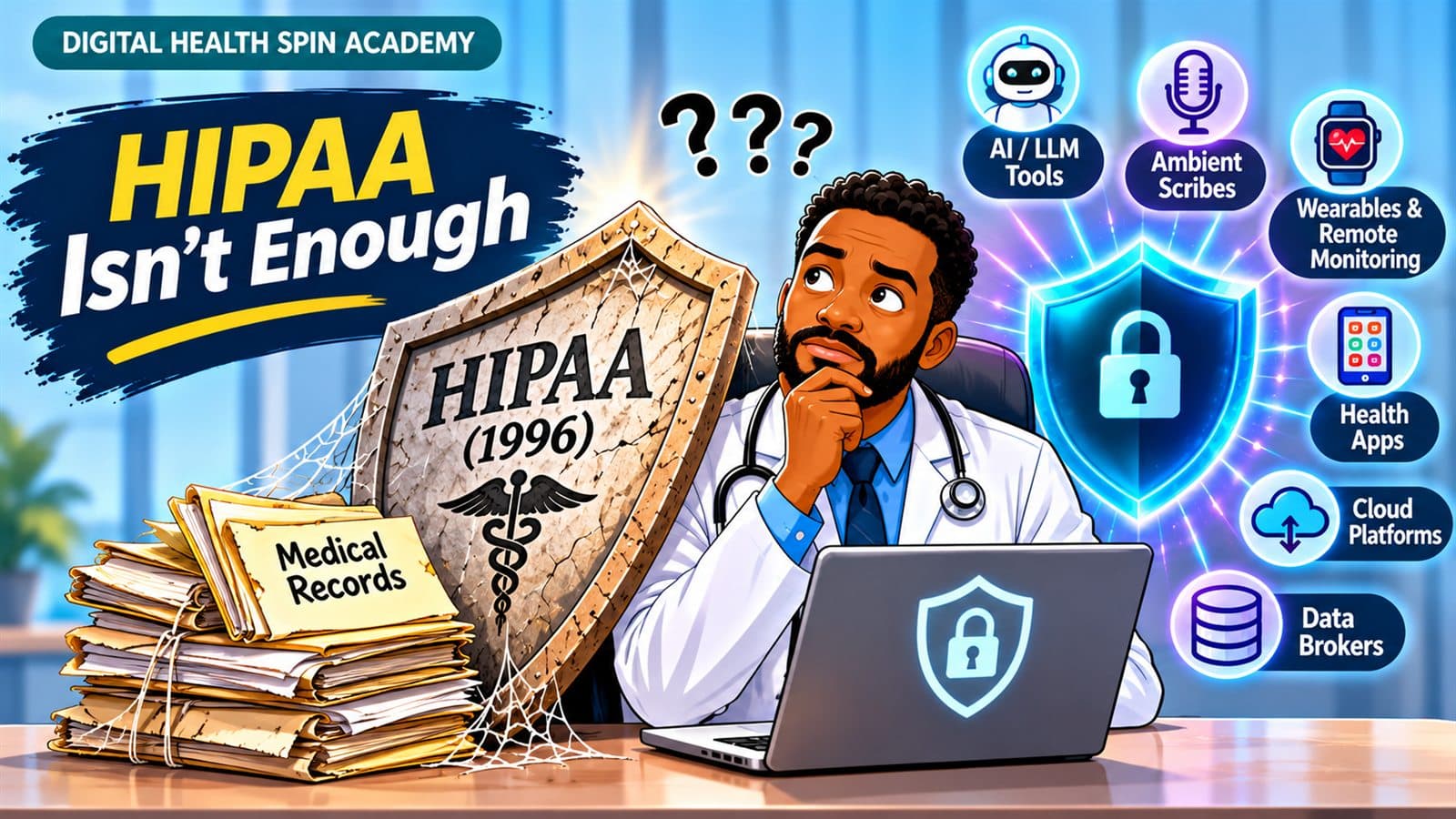
Congress passed the Health Insurance Portability and Accountability Act (HIPAA) in 1996, when "the cloud" was still a weather term and most medical records lived in manila folders (Health Insurance Portability and Accountability Act [HIPAA], 1996).
HIPAA applies to covered entities: health plans, healthcare clearinghouses, and providers who transmit health information electronically, such as hospitals, physician practices, pharmacies and nursing homes (U.S. Department of Health and Human Services [HHS], n.d.-a). It protects protected health information (PHI), such as diagnoses, lab results, medication lists, insurance details and appointment dates tied to a name.
Beyond privacy, HIPAA also covers insurance portability, administrative simplification (standard electronic transactions and provider identifiers) and healthcare fraud and abuse enforcement (HIPAA, 1996).
Why HIPAA Falls Short in the Age of AI
Today, HIPAA is badly outdated. Much health data now flows entirely outside HIPAA, through apps, wearables and consumer platforms (Cohen & Mello, 2018; Price & Cohen, 2019). It also says little about how AI and large language model (LLM) tools, such as ambient scribes, clinical decision support and remote patient monitoring, collect, process and reuse data (Marks & Haupt, 2023).
Clinicians who adopt new tools in good faith face legal and compliance consequences when they fall into HIPAA's gaps.
Below are practical steps to protect patient data and limit your liability with any digital health tool, including AI.
HIPAA was written for manila folders and fax machines. Today's AI scribes, chatbots and data brokers operate in gaps the law never imagined.
5 Reasons HIPAA Can't Keep Up With Digital Health
1. The Data Explosion Has Outpaced the Law
The fourth industrial revolution exploded the volume, velocity, variety and veracity of data, known as the "four V's" of big data (Raghupathi & Raghupathi, 2014). HIPAA has not kept pace. Stakeholders have also multiplied beyond covered entities. Data brokers now combine health data with claims, financial and even social media data and sell the bundles, often outside HIPAA entirely.
2. Healthcare Is a Slow Adopter of Technology
Healthcare sits near the laggard end of the technology adoption curve. Banking and aviation adopted earlier and protect data far better. Meanwhile, healthcare is still in a committed relationship with the fax machine.
3. Built-In Inefficiency Slows Every Fix
Fragmented systems, competing priorities and endless committee approvals mean privacy safeguards are often obsolete by the time they are approved.
4. A Polarized Congress Lacks the Political Will
Reform needs consensus, which a divided Congress rarely delivers, leaving a patchwork of state laws and clinicians guessing.
5. Health Data Is the New Gold
Health records attract legal data brokers and criminals alike. The 2024 ransomware attack on Change Healthcare affected an estimated 192.7 million people, the largest healthcare breach on record (Becker's Hospital Review, 2025).
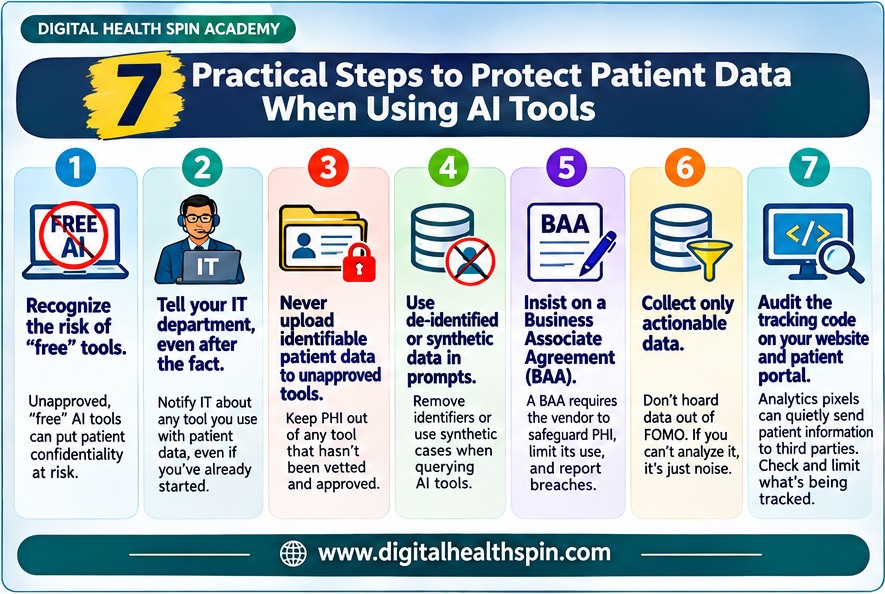
7 Practical Steps to Protect Patient Data When Using AI Tools
1. Recognize the risk of "free" tools. Free AI tools, especially ones your institution has not approved, can put patient confidentiality at risk. If you are not paying for the product, your data may be the product. It's an open secret: in a 2025 survey, 17% of hospital staff admitted using unauthorized AI tools (Wolters Kluwer, 2026).
If you are not paying for the AI tool, your patients' data may be the product. Free is never free when protected health information is involved.
2. Tell your IT department, even after the fact. Vetting is slow outside big academic centers, but notify IT about any tool you use with patient data, even if you've already started. Disclosure spreads the liability and brings in expert review. No IT department, or no budget for one? Use a reputable automated security tool to vet any AI or digital health tool before you roll it out across your practice.
3. Never upload identifiable patient data to unapproved tools. In September 2026, a Johns Hopkins Bayview employee uploaded a patient spreadsheet to an unapproved AI tool, and the hospital had to notify more than 3,000 patients (HealthExec, 2026). Yikes!
4. Use de-identified or synthetic data in prompts. When querying clinical decision support, remove identifiers or use synthetic cases. See our guide to safe LLM prompting for clinicians.
5. Insist on a business associate agreement (BAA). A BAA is a contract that requires a vendor who handles PHI on your behalf to safeguard it, limit how it is used and report breaches (HHS, n.d.-b). No BAA, no PHI. Period.
6. Collect only actionable data. Don't hoard data out of fear of missing out (FOMO). Data you cannot analyze is like glucose in a patient with insulin resistance or uncontrolled diabetes: plenty in the bloodstream, none of it doing any good. Syncing smartwatch data into your EHR sounds cool, but much of it is noise. Be data prudent.
7. Audit the tracking code on your website and patient portal. Analytics pixels can quietly leak patient information. Advocate Aurora Health's pixels may have exposed data from as many as 3 million patients, leading to a roughly $12 million settlement (Becker's Hospital Review, 2023).
📥 Download the free 1-page checklist (PDF)
Free for members. Not a member yet? You'll be asked to sign up or log in, then the download starts automatically.
View the 7 steps as a table
| # | Step | What to Do | Why It Matters |
|---|---|---|---|
| 1 | Recognize the risk of "free" tools | Treat any AI tool your institution has not approved as a privacy risk. | If you are not paying for the product, your data may be the product. 17% of hospital staff admit using unauthorized AI tools. |
| 2 | Tell your IT department, even after the fact | Report every digital health tool you use with patient data, including ones you already use. | Disclosure spreads the liability and brings in expert review. |
| 3 | Never upload identifiable patient data to unapproved tools | Keep protected health information (PHI) inside systems your institution has approved. | In 2026, one employee's upload to an unapproved AI tool forced Johns Hopkins Bayview to notify 3,000+ patients. |
| 4 | Use de-identified or synthetic data in prompts | Remove identifiers, or use synthetic cases, when querying clinical decision support. | If there is no PHI in the prompt, there is no PHI to leak. |
| 5 | Insist on a business associate agreement (BAA) | Confirm a signed BAA before any vendor handles PHI on your behalf. | A BAA legally binds the vendor to safeguard PHI and report breaches. No BAA, no PHI. |
| 6 | Collect only actionable data | Skip "nice-to-have" data feeds you collect out of fear of missing out (FOMO). | Data you cannot analyze is just noise, and every extra record is one more thing to protect. |
| 7 | Audit the tracking code on your website and patient portal | Ask your web vendor exactly what pixels and analytics tools share, and with whom. | Advocate Aurora Health's tracking pixels may have exposed data on as many as 3 million patients, leading to a roughly $12M settlement. |
Source: Digital Health Spin, digitalhealthspin.com. Educational information, not legal advice.
The Digital Health Spin Perspective
The digital health revolution is still unfolding, and data and AI governance are taking a back seat to hype over "cool" tools. Regulators lack the shared vision and political will to build guardrails, leaving clinicians to figure it out alone. Nobody is coming to save us: not the federal government, and not the vendors.
Nobody is coming to save us, not the federal government and not the vendors. Protecting patient data in the AI era starts with the clinician.
The most important safeguard is understanding the risks every new tool brings, and keeping IT in the loop.
Remember, too, that more data does not mean better care. The more unactionable data you accumulate, the greater your security risk, and cloud storage carries a growing environmental cost.
Enjoyed this? Get digital health insights, sans hype.
Our free newsletter lands in your inbox every two weeks with evidence-based analysis for clinicians and health leaders.
Join the conversation: LinkedIn group · X · Facebook
In Good Health,
The Digital Health Spin Framework™
Your guide to health innovation through:
Clinical Value • Health Equity • Economic Sustainability • Environmental Sustainability
References
1. Becker's Hospital Review. (2023). Advocate Aurora settles pixel suit for $12M. https://www.beckershospitalreview.com/healthcare-information-technology/advocate-aurora-settles-pixel-suit-for-12m
2. Becker's Hospital Review. (2025). Change Healthcare data breach toll reaches 192.7 million. https://www.beckershospitalreview.com/healthcare-information-technology/cybersecurity/change-healthcare-data-breach-toll-reaches-192-7-million
3. Cohen, I. G., & Mello, M. M. (2018). HIPAA and protecting health information in the 21st century. JAMA, 320(3), 231–232. https://doi.org/10.1001/jama.2018.5630
4. HealthExec. (2026). Medical records on over 3K patients exposed after spreadsheet shared with AI platform. https://healthexec.com/topics/health-it/cybersecurity/medical-records-over-3k-patients-exposed-after-spreadsheet-shared-ai-platform
5. Health Insurance Portability and Accountability Act of 1996, Pub. L. No. 104-191, 110 Stat. 1936 (1996). https://www.govinfo.gov/content/pkg/PLAW-104publ191/pdf/PLAW-104publ191.pdf
6. Marks, M., & Haupt, C. E. (2023). AI chatbots, health privacy, and challenges to HIPAA compliance. JAMA, 330(4), 309–310. https://doi.org/10.1001/jama.2023.9458
7. Price, W. N., & Cohen, I. G. (2019). Privacy in the age of medical big data. Nature Medicine, 25(1), 37–43. https://doi.org/10.1038/s41591-018-0272-7
8. Raghupathi, W., & Raghupathi, V. (2014). Big data analytics in healthcare: Promise and potential. Health Information Science and Systems, 2, Article 3. https://doi.org/10.1186/2047-2501-2-3
9. U.S. Department of Health and Human Services. (n.d.-a). Covered entities and business associates. https://www.hhs.gov/hipaa/for-professionals/covered-entities/index.html
10. U.S. Department of Health and Human Services. (n.d.-b). Business associate contracts: Sample business associate agreement provisions. https://www.hhs.gov/hipaa/for-professionals/covered-entities/sample-business-associate-agreement-provisions/index.html
11. Wolters Kluwer. (2026, January 22). Shadow AI: Providers are using unapproved tools to improve workflow. https://www.wolterskluwer.com/en/expert-insights/shadow-ai-providers-are-using-unapproved-tools-to-improve-workflow